Things to Do in Le Marais Paris: 15 Places and Experiences You Shouldn’t Miss
Le Marais is one of those Paris neighborhoods where getting slightly lost is part of the experience.
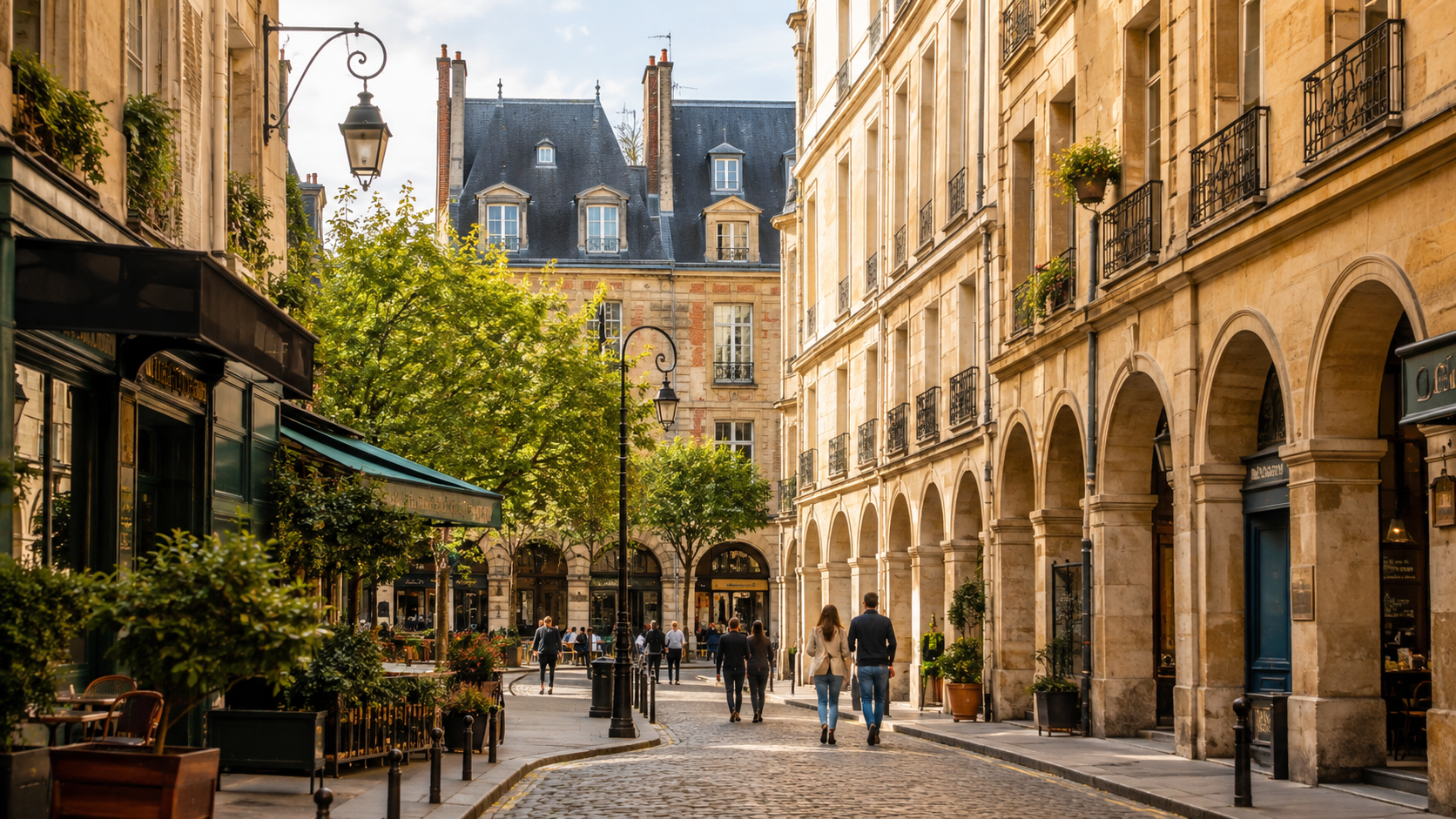
Spread across the 3rd and 4th arrondissements, this historic district combines medieval streets, elegant mansions, hidden courtyards, independent shops, museums, cafés and some of the best people-watching in the city.
If you are looking for the best things to do in Le Marais Paris, you do not need a rigid itinerary. The neighborhood is compact enough to explore on foot, and many of its most interesting places appear naturally as you wander between its narrow streets.
This guide brings together 15 places and experiences worth including in your visit, from famous landmarks such as Place des Vosges to quieter corners that reveal another side of Paris.
1. Start at Place des Vosges
Place des Vosges is one of the most beautiful squares in Paris and a perfect starting point for exploring Le Marais.
Built in the early 17th century, the square is surrounded by symmetrical red-brick buildings, covered arcades and a central garden where locals and visitors stop to sit beneath the trees.
Walk beneath the arcades before entering the garden itself. Small galleries and cafés hide behind the arches, while the benches and lawns in the center offer a peaceful place to plan the rest of your walk.
The square is especially pleasant early in the morning, before the neighborhood becomes busier.
From here, many of the most interesting streets of Le Marais are only a few minutes away.
2. Visit Victor Hugo’s House
At number 6 Place des Vosges you will find the former home of Victor Hugo, author of Les Misérables and The Hunchback of Notre-Dame.
The museum occupies the apartment where Hugo lived between 1832 and 1848 and provides an interesting glimpse into both his work and his private life.
Rooms are arranged around different periods of the writer’s life, with furniture, drawings, manuscripts and personal objects helping to place his work within nineteenth-century Paris.
Even if literature is not the main reason for your trip, it is an easy cultural stop to combine with Place des Vosges before continuing deeper into Le Marais.
3. Wander Through the Historic Streets of Le Marais
One of the best things to do in Le Marais is also the simplest: walk.
Unlike some parts of Paris dominated by broad Haussmannian boulevards, Le Marais still preserves a maze of narrower streets that reflect the city’s older urban layout.
Rue des Francs-Bourgeois, Rue Vieille du Temple and Rue des Rosiers are among the best-known streets, but do not limit yourself to them.
Turn into smaller side streets, look through open gateways and pay attention to courtyards, old doors, stone façades and architectural details.
Some streets feel elegant and polished. Others retain a much more local character. The contrast is part of what makes the neighborhood so enjoyable to explore.
Le Marais rewards travelers who move slowly rather than simply walking from one attraction to the next.
Want to Explore Paris in a Different Way?
If you enjoy discovering a city through clues, stories and challenges, Escape The Museum turns famous Paris museums into interactive experiences you can play at your own pace.
4. Explore the Musée Carnavalet
If you want to understand Paris rather than simply photograph it, the Musée Carnavalet is one of the most interesting museums in Le Marais.
Dedicated to the history of Paris, its collections cover centuries of life in the city, from archaeology and royal Paris to the French Revolution and the transformation of the capital in modern times.
The museum itself occupies two historic mansions, making the buildings almost as interesting as some of the exhibits.
This is a particularly good stop if you have already visited the city’s major art museums and want something different.
It also adds context to everything else you see while walking around Paris. Streets, monuments and neighborhoods become more meaningful once you begin to understand how the city developed.
Allow at least an hour if you want a quick visit, although history lovers could easily stay considerably longer.
5. Discover the Jewish Quarter Around Rue des Rosiers
Rue des Rosiers and the surrounding streets form the historic heart of the Jewish quarter of Le Marais.
Today the area mixes its Jewish heritage with fashion shops, bakeries, restaurants and cafés, but traces of its history remain an essential part of the neighborhood’s identity.
Walk slowly through Rue des Rosiers and the nearby streets rather than treating it simply as somewhere to stop for food.
Look for bakeries selling traditional pastries, Jewish bookshops and plaques that recall the area’s history.
The street can become extremely busy around lunchtime and at weekends, so morning is a good time to explore if you prefer a quieter atmosphere.
6. Try a Falafel on Rue des Rosiers
Food has become part of the Le Marais experience, and falafel is probably its most famous quick meal.
Several restaurants around Rue des Rosiers serve pita filled with falafel, vegetables, sauces and other toppings.
Queues outside the most famous addresses can become surprisingly long, particularly at lunchtime.
Do not feel that you necessarily need to join the longest queue. There are several options in the immediate area, and wandering around before choosing where to eat is part of the fun.
It is also a convenient meal if you want to continue exploring rather than spend an hour sitting in a restaurant.
Grab your food, find somewhere suitable nearby and then continue toward the northern part of Le Marais.
7. Visit the Musée Picasso
Le Marais has an unusually high concentration of museums, and the Musée Picasso is one of its most important.
Located inside the Hôtel Salé, a seventeenth-century mansion, the museum houses a major collection connected with Pablo Picasso’s work and life.
Paintings, sculptures, drawings and other pieces show how dramatically his style evolved during his career.
Even visitors who are not particularly interested in Picasso may enjoy the contrast between the historic building and modern artwork inside.
If you are planning several museums during your stay, try not to visit all of them on the same day. Le Marais is at its best when museum visits are mixed with walking, food and time outdoors.
8. Step Inside the Garden of the Hôtel de Sully
One of the pleasures of exploring Le Marais is discovering spaces that are almost invisible from the street.
The Hôtel de Sully is a good example.
Located close to Place des Vosges, this seventeenth-century mansion has an elegant courtyard and garden that provide a brief escape from the surrounding streets.
You do not need a long visit. Simply walking through gives you a sense of the private mansions that once shaped this part of Paris.
These small discoveries are one reason Le Marais works so well as a self-guided walking area.
Instead of following only the major sights, keep an eye open for gateways and passages that reveal another layer of the neighborhood.
9. See the Centre Pompidou Area
On the western edge of Le Marais, the Centre Pompidou provides one of the sharpest architectural contrasts in central Paris.
Its exposed structural elements, pipes and industrial appearance could hardly be more different from the historic mansions and narrow streets you have just walked through.
Even if you do not plan to visit the museum itself, the surrounding area is worth including on your route.
Street performers, cafés and pedestrians give the square a completely different atmosphere from quieter corners of Le Marais.
It is also a useful reminder that Paris is not a city frozen in the nineteenth century. Part of its appeal comes from the collision between different eras.
From here, you can either continue toward Hôtel de Ville and the Seine or turn back into the smaller streets of Le Marais.
10. Search for Hidden Courtyards and Passages
Some of the most memorable places in Paris are not major attractions at all.
Le Marais contains courtyards, passages and small gardens that are easy to walk past without noticing.
Not every doorway is open to the public, of course, but when a courtyard or passage clearly allows access, take a moment to look inside.
This style of exploration changes the way you experience the neighborhood.
Rather than constantly checking a list of attractions, you begin looking at the city itself.
Architectural details become clues. A gateway may reveal a mansion. A narrow passage can connect two busy streets. A small garden may provide a quiet break only metres away from crowds.
If you enjoyed exploring Paris this way, our Montmartre walking tour follows the same idea: slow down, walk and discover details that are easy to miss.
11. Browse Independent Shops and Boutiques
Le Marais is one of Paris’s best neighborhoods for browsing without necessarily knowing what you are looking for.
You will find fashion boutiques, vintage shops, design stores, bookshops and small independent businesses alongside international brands.
Rue Vieille du Temple and surrounding streets contain plenty of options, but again, the most enjoyable approach is usually to wander rather than follow a shopping itinerary.
Even if shopping is not a priority, the shops contribute to the neighborhood’s atmosphere and make it easy to combine sightseeing with unplanned stops.
If you are traveling with teenagers, this can also provide a useful change of pace between museums and historical sights.
Allow some flexibility in your schedule. Le Marais is exactly the kind of neighborhood where a planned ten-minute walk can easily turn into an hour.
12. Visit the Marché des Enfants Rouges
For a different side of Le Marais, head north toward the Marché des Enfants Rouges.
Dating back to the seventeenth century, it is often described as the oldest covered market in Paris still operating today.
The market is relatively small, but its food stalls make it an excellent lunch stop.
You will find a mixture of cuisines rather than a purely traditional French market experience, which reflects the international character of modern Paris.
It can become crowded around lunchtime, so arriving slightly before or after the busiest period makes the experience more relaxed.
The surrounding streets of the Haut-Marais are also worth exploring and generally feel different from the more tourist-heavy area around Rue des Rosiers and Place des Vosges.
13. Walk Through the Village Saint-Paul
Close to the Seine and the southeastern edge of Le Marais, Village Saint-Paul is a network of interconnected courtyards and passages.
Antique shops, galleries and small businesses occupy the spaces between old buildings, creating an atmosphere that feels surprisingly removed from the busier streets nearby.
You do not need to come here with the intention of buying antiques.
The pleasure is in exploring the courtyards and seeing a quieter side of central Paris.
Village Saint-Paul is especially worthwhile if your idea of sightseeing involves discovering spaces rather than checking famous landmarks off a list.
Combine it with Place des Vosges and the Hôtel de Sully for an easy walk through some of the historic architecture of the eastern Marais.
14. Walk Down to the Seine and Hôtel de Ville
One advantage of exploring Le Marais is its position in the center of Paris.
From the southern part of the neighborhood, it is only a short walk to Hôtel de Ville and the Seine.
The change in scenery is immediate.
After spending several hours among narrow streets, you suddenly emerge into the much wider space around the river.
From here, you can see Île de la Cité and continue toward Notre-Dame, cross to the Left Bank or simply walk along the Seine.
This makes Le Marais easy to combine with a broader day of sightseeing without requiring complicated transport.
If you have limited time in the city, you can also incorporate the neighborhood into a one-day Paris itinerary rather than treating it as an isolated destination.
15. Finish With No Destination at All
This might sound like a strange recommendation in a guide to the best things to do in Le Marais Paris, but leave at least part of your visit unplanned.
Once you have seen the places that interest you most, put the map away for a while.
Choose an appealing street and follow it.
Turn when something catches your attention.
Stop for coffee if you find a café you like. Walk into a bookshop. Look through an open courtyard. Sit in a square.
Some neighborhoods are best experienced through landmarks. Le Marais is better understood as a collection of streets, buildings, shops, museums and small discoveries.
A little unstructured time often becomes the most memorable part of the visit.
How Long Do You Need in Le Marais?
You can see some of the main sights in around two or three hours, but half a day is a much better amount of time for most visitors.
That gives you enough time to walk through the neighborhood, visit one museum, stop for food and explore without constantly watching the clock.
A full day also works well if you want to visit several museums or spend time shopping.
If this is your first trip to Paris, however, you probably do not need to dedicate an entire day exclusively to Le Marais.
Its central location makes it easy to combine with the Seine, Notre-Dame, Île de la Cité or other nearby areas.
Is Le Marais Walkable?
Yes. Walking is by far the best way to explore Le Marais.
Distances between the main sights are relatively short, and much of the appeal comes from what you discover between them.
Public transport is useful for reaching the neighborhood, but once you arrive, repeatedly taking the Métro would mean missing much of what makes the area interesting.
Comfortable shoes are more useful here than a complicated transport plan.
If you enjoy discovering cities independently, you may also want to explore our guide to a self-guided walking tour of Paris, which connects naturally with this style of travel.
What Is the Best Time to Visit Le Marais?
Morning is excellent if you want quieter streets and easier photographs.
Late morning through the afternoon brings more energy, with shops, cafés and restaurants in full swing.
Weekends tend to be busier, particularly around the most popular shopping and food streets.
If possible, arrive in the morning and stay through lunchtime. You will experience both the quieter and more animated sides of the neighborhood.
Weather also matters less here than in some parts of Paris because museums, shops, cafés and covered spaces provide plenty of options if conditions change.
Is Le Marais Good for Families and Teenagers?
Yes, particularly if you mix cultural stops with walking, food and shopping.
Trying to visit several museums consecutively can become tiring for younger travelers, but Le Marais makes it easy to alternate activities.
You might visit a museum, walk through Rue des Rosiers, stop for something to eat, browse shops and then continue toward Place des Vosges.
For families who want something more interactive than a conventional museum visit, our Paris museum games are designed to turn cultural sightseeing into a challenge rather than simply walking from room to room.
That can be especially useful when visiting Paris with teenagers who are less enthusiastic about traditional guided tours.
A Simple Le Marais Walking Route
If you want an easy route without planning every street in advance, try this order:
- Place des Vosges
- Maison de Victor Hugo
- Hôtel de Sully
- Rue des Rosiers
- Musée Carnavalet
- Rue Vieille du Temple
- Musée Picasso
- Marché des Enfants Rouges
- Walk south again through the smaller streets
- Centre Pompidou
- Hôtel de Ville and the Seine
Do not worry about following this route precisely.
Le Marais is compact enough that small detours rarely create problems, and those detours are often where you find the most interesting places.
Le Marais or Montmartre: Which Should You Visit?
If you have enough time, visit both because they offer very different experiences.
Montmartre is hillier and more immediately picturesque, with Sacré-Cœur, steep streets, viewpoints and the artistic mythology surrounding the neighborhood.
Le Marais is flatter, denser and more varied. History, museums, architecture, shopping, Jewish heritage, food and contemporary Paris all overlap within a relatively small area.
For a first trip, there is no need to choose one permanently over the other.
Le Marais fits easily into a central Paris itinerary, while Montmartre works particularly well as a dedicated half-day walk.
Why Le Marais Is Worth Exploring
Paris has no shortage of famous sights.
The Eiffel Tower, Louvre, Notre-Dame and Arc de Triomphe deserve their reputation, but spending your entire trip moving between major monuments can make the city feel like a collection of attractions rather than a real place.
Le Marais offers something different.
Here the experience comes from the combination of individual sights and everything between them.
A seventeenth-century mansion sits beside a fashion boutique. A medieval street leads toward contemporary art. A busy food district gives way to a quiet courtyard.
That mixture is what makes the neighborhood one of the most enjoyable areas of Paris to explore on foot.
And because there is no single attraction that defines Le Marais, every visitor can build a slightly different version of the neighborhood.
Turn Your Paris Visit Into an Adventure
If you like exploring independently rather than simply following a guide, continue the experience inside two of Paris’s greatest museums.
Escape The Museum offers self-guided games for the Louvre and Musée d’Orsay, combining art, observation and challenges so you can discover the collections in a different way.