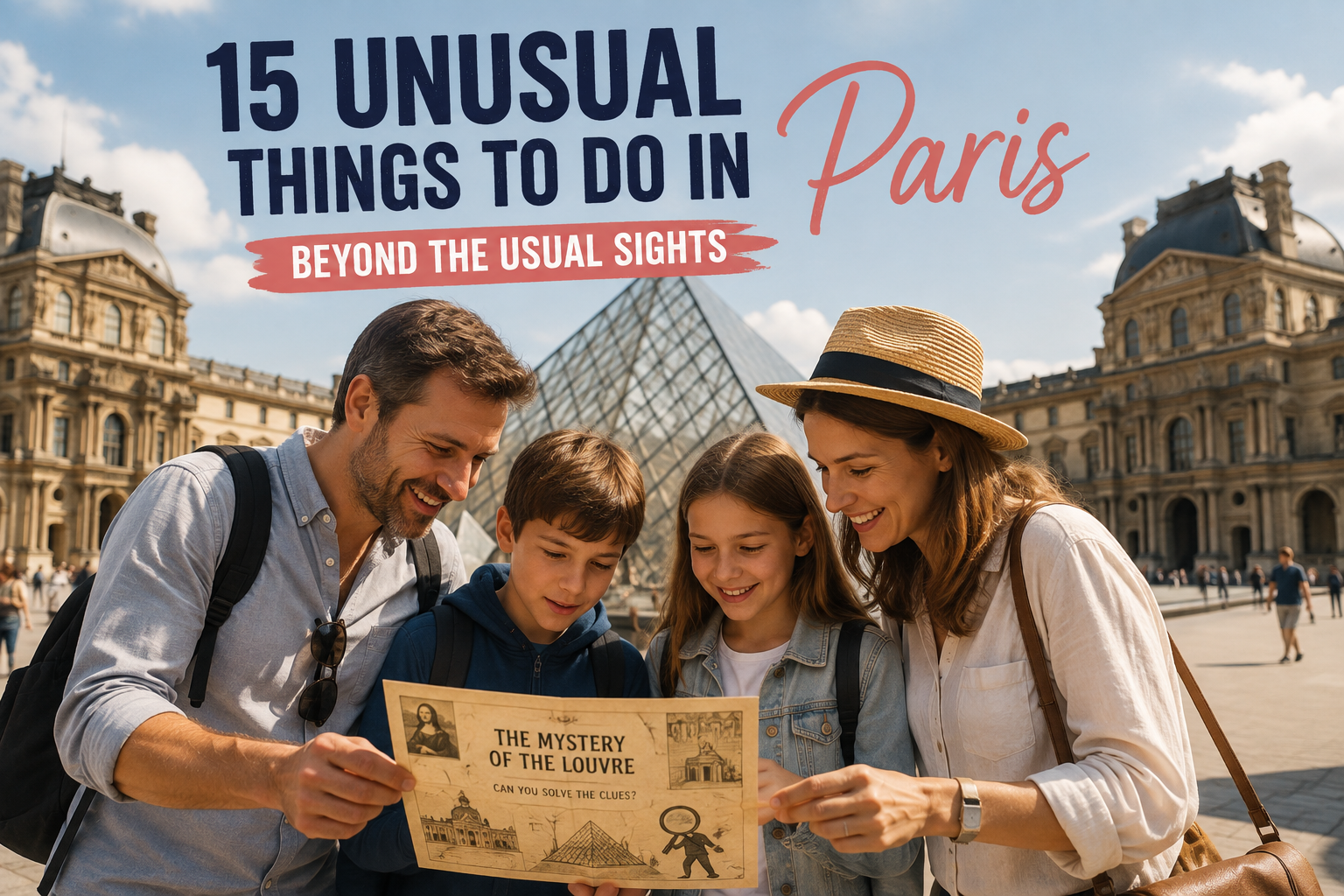
15 Unusual Things to Do in Paris Beyond the Usual Sights
Paris is famous for the Eiffel Tower, the Louvre, Notre-Dame and the Champs-Élysées. They deserve their reputation, but they are only one version of the city.
If you are searching for unusual things to do in Paris, you probably want something different: hidden streets, surprising museums, atmospheric neighborhoods, unusual viewpoints and experiences that turn sightseeing into something more memorable.
The good news is that Paris rewards curiosity.
Walk a few streets away from the major attractions and the city begins to change. You can explore underground tunnels, hunt for clues inside world-famous museums, discover covered passages from another century or wander through neighborhoods where the journey itself becomes the attraction.
This guide brings together 15 unusual Paris experiences for travelers who want to go beyond the standard sightseeing checklist.
1. Turn the Louvre Into a Scavenger Hunt
The Louvre is one of the greatest museums in the world. It is also enormous.
For some visitors, particularly families and teenagers, walking from masterpiece to masterpiece can eventually become exhausting. One way to completely change the experience is to turn the museum visit into a game.
Instead of simply looking at paintings and sculptures, you can search for details, solve clues and follow a challenge through the galleries.
This transforms the museum from somewhere you passively visit into somewhere you actively explore.
It is particularly useful if you are visiting Paris with teenagers who might not naturally be enthusiastic about spending several hours inside an art museum.
At Escape The Museum, our Louvre experience is designed around exactly this idea: exploring the museum while solving a story-driven series of challenges.
The Louvre itself remains the star of the visit. The game simply gives you another reason to look carefully at what surrounds you.
If you are searching for unusual things to do in Paris with your family, this is one of the easiest ways to make a famous attraction feel completely different.
Make Your Louvre Visit Part of the Adventure
Visiting the Louvre? Turn your museum visit into an interactive adventure. Follow a story, search for hidden details and solve challenges as you explore the galleries — at your own pace, with no guide and no fixed schedule.
2. Explore the Paris Catacombs
Beneath the streets of Paris lies a very different city.
The Catacombs of Paris contain underground galleries created in former quarries, part of which became an ossuary containing the remains of millions of Parisians.
Descending below street level is an extraordinary contrast with the elegant boulevards above.
The experience is dark, historical and slightly unsettling — which is exactly what makes it one of the most unusual places to see in Paris.
It also reveals something important about the city: much of Paris has layers that are invisible from the surface.
Why the Catacombs are different
Most Paris attractions celebrate the city’s architecture, art or beauty.
The Catacombs reveal another side of its history.
They are particularly interesting for older children and teenagers who enjoy mysterious places, underground spaces or unusual historical stories.
Because access can be limited, it is worth checking the official Catacombs information and booking conditions before your visit.
3. Wander Through the Covered Passages of Paris
Long before modern shopping centers existed, Paris had its passages couverts.
These covered shopping arcades appeared mainly during the 19th century and created elegant pedestrian routes filled with shops, cafés and decorative architecture.
Several survive today.
Among the best known are:
- Galerie Vivienne
- Passage des Panoramas
- Passage Jouffroy
- Passage Verdeau
Walking through them feels like stepping into an older version of Paris.
Glass ceilings, mosaic floors, old bookshops and small independent stores make the passages a wonderful alternative to the city’s busiest shopping streets.
They are also useful when the weather is unpredictable because much of the exploration happens under cover.
If you enjoy finding alternative things to do in Paris, connect several passages together and turn them into a walking route rather than visiting only one.
4. Discover Montmartre Beyond Sacré-Cœur
Most visitors to Montmartre follow a predictable route.
They climb towards Sacré-Cœur, walk through Place du Tertre, take photographs and head back down.
But Montmartre becomes much more interesting when you leave that route.
Explore the quieter streets behind the crowds and you will discover staircases, tiny squares, old houses and traces of the neighborhood’s artistic past.
Look for places such as:
- Rue de l’Abreuvoir
- Place Dalida
- the exterior of the Moulin de la Galette
- the remaining Montmartre vineyard
- small streets around Lamarck-Caulaincourt
Make the walk itself the experience
Montmartre is particularly suited to independent exploration because there is no single monument you need to reach.
The neighborhood is the attraction.
That makes it ideal for a self-guided walking experience where you follow a route, uncover stories and pay attention to details you might otherwise walk past.
Montmartre is also one of the areas where we believe the combination of walking + discovering + solving challenges works especially well.
If you enjoy exploring cities independently, keep Montmartre high on your list.
5. Visit Musée de la Chasse et de la Nature
Paris has dozens of museums, but they are not all conventional art museums.
The Musée de la Chasse et de la Nature — the Museum of Hunting and Nature — is one of the city’s more unexpected cultural experiences.
Its collections explore relationships between humans and animals through art, objects and historical artifacts.
What makes it memorable is the atmosphere.
The museum feels part cabinet of curiosities, part historic residence and part art collection.
Even travelers who would not normally search for a museum about hunting may find the presentation surprisingly engaging.
It is a good example of why some of the best unusual Paris experiences come from choosing a smaller museum rather than automatically visiting another famous attraction.
6. Search for Parisian Street Art
Paris may be associated with classical architecture, but some neighborhoods provide a completely different visual experience.
Street art has become particularly visible in areas such as the 13th arrondissement and Belleville.
In the 13th, enormous murals cover the sides of residential buildings. Elsewhere, smaller works appear on shutters, walls and unexpected corners.
The interesting part is that street art encourages you to look differently at the city.
You stop concentrating exclusively on monuments and start paying attention to ordinary streets.
Turn it into your own urban hunt
Choose an area and see how many murals, mosaics or unusual pieces you can find.
You do not necessarily need a formal tour.
Photograph your favorites, compare discoveries and make the walk itself into a small scavenger hunt.
For families or groups, this can become one of the simplest quirky things to do in Paris without requiring an entire day.
7. Explore Père Lachaise Cemetery
Visiting a cemetery might sound like a strange recommendation for a holiday.
Père Lachaise is different.
It is enormous, atmospheric and filled with elaborate monuments, sculptures and tree-lined paths.
Many famous people are buried here, including Oscar Wilde, Édith Piaf, Frédéric Chopin and Jim Morrison.
But searching only for famous graves misses part of the experience.
Walk slowly and look at the architecture of the tombs. Some resemble miniature chapels, while others are covered in sculptures or unusual symbols.
The cemetery feels almost like a city within the city.
Explore with a mission
Before entering, choose several graves or monuments you want to locate.
Finding them among the winding paths adds an element of exploration to the visit.
It is another example of how having a small objective can turn a simple walk into a much more engaging experience.
8. See Another Side of Paris Along Canal Saint-Martin
Paris is defined by the Seine, but it is not the city’s only interesting waterway.
Canal Saint-Martin offers a more relaxed environment with bridges, locks and tree-lined sections that feel very different from central Paris.
Instead of rushing between major landmarks, come here to walk.
Watch the locks operate, cross the small bridges and explore the surrounding streets.
The area is particularly enjoyable when you want a break from intensive sightseeing.
Pick up something to eat, sit near the canal or simply follow the water for a while.
This is the kind of experience that rarely dominates first-time Paris itineraries but can become one of the moments you remember most.
9. Explore the Musée d’Orsay Like a Detective
The Musée d’Orsay is famous for its extraordinary collection of Impressionist and Post-Impressionist art.
But, just like the Louvre, it can be explored in more than one way.
Instead of trying to see everything, slow down.
Look for small details inside paintings. Compare characters, settings, colors and objects. Try to understand what might be happening beyond the obvious subject of each work.
This style of observation works especially well with children and teenagers because it gives them something concrete to search for.
Add a challenge to your museum visit
Our Musée d’Orsay game uses the museum as the setting for a series of challenges.
Rather than replacing the artworks with a screen-based activity, the aim is to encourage visitors to observe them more carefully.
That combination of art, exploration and puzzles is exactly the kind of experience Escape The Museum was created around.
For travelers who like museums but want something more interactive, it offers an alternative way to discover one of Paris’s essential collections.
10. Find the Petite Ceinture
Paris once had a railway running around much of the city.
Known as the Petite Ceinture, or Little Belt, the line gradually lost its original role as the modern transport network developed.
Sections of the old railway have since been transformed or opened for public access.
The result is one of the more surprising sides of Paris: old railway infrastructure partly reclaimed by vegetation.
It is not a single attraction with one entrance and one route. Different sections have different characteristics and access conditions.
That is part of its appeal.
Discovering traces of the old railway provides a glimpse of a Paris that feels far removed from the monumental center.
Before visiting, check which sections are currently accessible.
11. Discover Rue Crémieux — Without Treating It Like a Film Set
Rue Crémieux became famous because of its colorful houses.
The small pedestrian street in the 12th arrondissement looks unlike the grand Haussmannian Paris many visitors expect.
Its pastel façades make it visually distinctive, but there is an important point to remember:
people live here.
It is a residential street rather than a tourist attraction.
If you visit, walk through quietly, avoid blocking entrances and respect residents’ privacy.
This applies to many hidden or unusual places in Paris. Social media can transform ordinary neighborhoods into attractions almost overnight.
Discovering somewhere interesting should never mean making life difficult for the people who live there.
12. Look for the Arènes de Lutèce
Paris existed long before it became the Paris we recognize today.
Hidden within the Latin Quarter are the Arènes de Lutèce, remains of a Roman amphitheater dating from the ancient settlement of Lutetia.
The location is surprising because it is embedded within the modern city.
You can be walking through ordinary Parisian streets and suddenly encounter evidence of a city almost two thousand years older.
It is not as spectacular as the great Roman monuments found elsewhere in Europe, but that is precisely what makes it interesting.
It feels discovered rather than presented.
Combine it with a walk through the Latin Quarter rather than making a special journey only to see the arena.
13. Walk the Coulée Verte René-Dumont
New York’s High Line is internationally famous, but Paris developed an elevated park on former railway infrastructure years earlier.
The Coulée Verte René-Dumont, also known as the Promenade Plantée, follows part of an old railway route through eastern Paris.
Sections rise above street level, giving you an unusual perspective over surrounding buildings and streets.
Other parts pass through greener spaces and tunnels.
It is an excellent choice when you want to walk without simply moving from monument to monument.
Why it belongs on an alternative Paris itinerary
The Coulée Verte combines several things that make independent city exploration interesting:
history, architecture, greenery and changing perspectives.
You are still in Paris, but you experience the city from an unusual angle.
14. Explore the Less Obvious Corners of Le Marais
Le Marais is certainly not unknown.
It is one of Paris’s most popular neighborhoods.
But there is a major difference between visiting a neighborhood and exploring it.
Many people cross Le Marais while moving between shops, cafés and major sights. Instead, allow yourself time to investigate smaller streets, courtyards and architectural details.
Look beyond the obvious routes around Place des Vosges.
Notice old façades, private mansions, narrow passages and signs revealing how the neighborhood evolved.
This is a useful principle throughout Paris:
you do not always need to find a secret place; sometimes you simply need to explore a famous place differently.
Le Marais is perfect for that approach.
15. Create Your Own Paris Scavenger Hunt
One of the most unusual things you can do in Paris requires almost nothing.
Create a list before leaving your hotel and challenge yourself to find everything during the day.
For example:
- a Wallace fountain
- an Art Nouveau Metro entrance
- a tiny mosaic
- a street musician
- an unusual door knocker
- a hidden courtyard
- a view of the Eiffel Tower from an unexpected street
- a painting featuring an animal
- a date carved into a building
- a shop that appears to belong to another era
If you are traveling as a family, divide into teams or let each person choose several objects everyone must find.
Suddenly, walking between attractions becomes part of the entertainment.
This is particularly effective with teenagers because they have a reason to observe their surroundings rather than simply follow the adults through the city.
And that idea — explore, observe, discover and solve — is at the heart of our approach to experiencing Paris.
How to Build an Unusual Day in Paris
You do not need to spend your entire trip searching for obscure attractions.
In fact, one of the best ways to experience Paris is to combine the famous with the unexpected.
A day might look something like this:
Morning: Start with a Paris icon
Visit the Louvre or Musée d’Orsay while your energy levels are high.
Instead of attempting to see every gallery, choose the works that interest you most or turn the visit into a challenge.
Lunch: Leave the monument zone
Walk away from the busiest streets and find somewhere in a nearby neighborhood.
Even moving ten or fifteen minutes away from a major attraction can change the atmosphere.
Afternoon: Explore on foot
Choose Montmartre, Le Marais, the Latin Quarter or another walkable neighborhood.
Do not simply create a checklist of monuments.
Give yourself a route and enough time to investigate what you encounter between them.
Evening: Slow down
Finish around Canal Saint-Martin, explore a covered passage or simply walk through a neighborhood as the city changes from day to night.
The goal is not to accumulate attractions.
It is to create a day with contrast.
How to Find More Alternative Things to Do in Paris
The easiest way to discover a different Paris is to change the way you plan.
Instead of asking only “What should I see?”, ask:
“How do I want to experience the city?”
Do you want to solve something?
Walk somewhere?
Discover a neighborhood?
Search for hidden details?
Learn a strange story?
See art differently?
These questions often lead to more memorable experiences than another list of famous monuments.
Leave space in your itinerary
Overplanning makes discovery difficult.
If every hour has a reservation, you cannot follow an interesting street or spend another twenty minutes somewhere you unexpectedly enjoy.
Leave gaps.
Paris is particularly good at filling them.
Walk between nearby attractions
The Metro is excellent, but using it for every journey means missing much of the city.
When two places are reasonably close, walk.
The streets between attractions often produce the most unexpected discoveries.
Look beyond star ratings
The most popular attraction is not necessarily the experience you will remember most.
Small museums, neighborhood walks and unusual activities may have far fewer visitors but suit your interests much better.
Unusual Paris With Teenagers
Paris can be fantastic with teenagers, but the traditional formula of monument → museum → church → monument can become repetitive.
The solution is not necessarily to remove culture from the itinerary.
Change the way you experience it.
Combine major attractions with activities that involve:
- searching
- choosing routes
- solving
- photography
- walking
- food
- competition
- unusual stories
- independent exploration
A museum becomes more interesting when there is something to solve.
A neighborhood becomes more engaging when there is a mission.
A long walk becomes easier when there are things to find along the way.
This is one reason scavenger hunts and self-guided experiences work particularly well for families with older children.
They add purpose without forcing everyone into a conventional guided tour.
Famous Paris or Alternative Paris? Do Both
There is no need to choose between famous Paris and alternative Paris.
If it is your first visit, go to the Eiffel Tower.
See Notre-Dame.
Walk beside the Seine.
Visit the Louvre.
These places are famous for good reasons.
But leave room for something unexpected.
Go underground.
Follow an abandoned railway.
Explore a neighborhood without rushing.
Enter a museum you had never heard of.
Look for street art.
Turn a museum into a game.
The most interesting itinerary often combines places you have dreamed of seeing for years with places you did not know existed until that morning.
Explore Paris Differently
Paris does not need another attraction added to it to become interesting.
Sometimes you simply need another way to explore it.
At Escape The Museum, we create self-guided games designed to turn cultural visits into active experiences.
If you are visiting the Louvre or the Musée d’Orsay, you can explore the museum while following a story, observing artworks and solving challenges along the way.
No race through the galleries.
No need to replace the museum with your phone.
Just a different reason to look more closely.
Turn Your Paris Museum Visit Into an Adventure
Visiting the Louvre or Musée d’Orsay? Explore the masterpieces in a different way. Follow the story, look for hidden details and solve challenges as you make your way through the museum — at your own pace, with no guide and no fixed schedule.