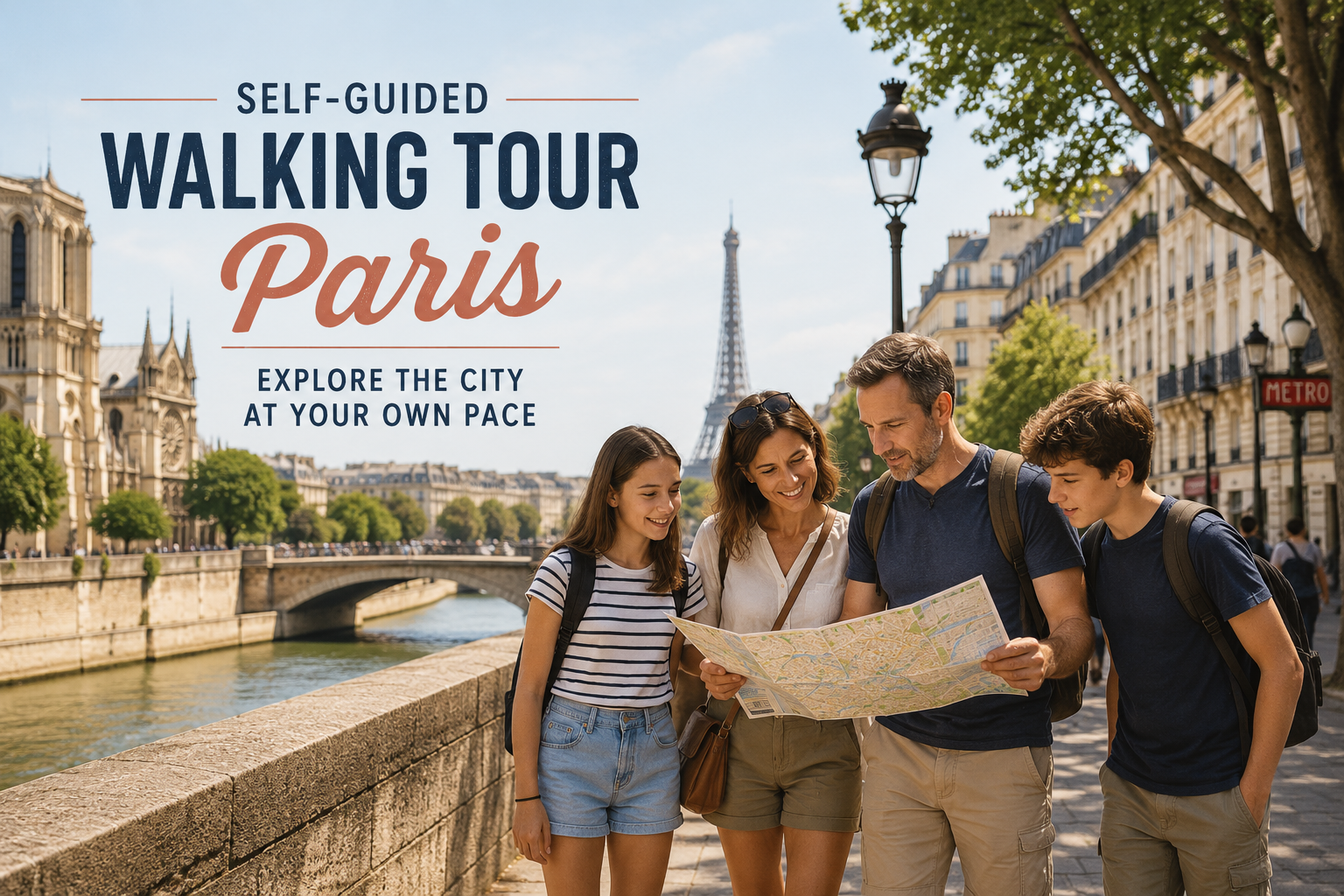
Self-Guided Walking Tour Paris: The Perfect Route to Explore the City on Foot
Looking for the best self-guided walking tour Paris has to offer? This carefully planned route takes you through the city’s most iconic landmarks, charming streets, and hidden corners at your own pace. Whether it’s your first visit or you’re returning to discover more, this itinerary helps you experience Paris without the constraints of a guided group.
Self-Guided Walking Tour Paris: Route at a Glance
| Distance | Walking Time | Stops | Best For | Cost |
|---|---|---|---|---|
| 5.6 km (3.5 miles) | 1.5-2 hours min(with stops) | 11 | First-time visitors, couples and families | Free (excluding attractions) |
Tip: Start early in the morning to enjoy quieter streets and leave plenty of time for museums, cafés and photo stops along the way.
Our route follows this general direction:
Notre-Dame → Île de la Cité → Seine → Pont Neuf → Louvre → Tuileries Garden → Place de la Concorde → Seine → Eiffel Tower
Open this walking route in Google Maps →
You do not need to complete every section. Think of this route as a flexible framework for exploring Paris at your own pace.
Stop whenever somewhere catches your attention, spend longer at the Louvre or Tuileries, or take a break at a café along the way. If you enter the Louvre, this self-guided walking tour can easily become a full-day experience.
The route is designed to work in either direction, so adapt it to your interests, energy level and available time.
How Long Does This Paris Walking Tour Take?
The complete route is approximately 5.6 km (3.5 miles) and takes around 1 hour 20 minutes of actual walking time without stops.
In practice, allow 4–5 hours to enjoy the route at a relaxed pace, with time for photos, cafés and exploring the neighborhoods along the way.
If you visit the Louvre, the tour can easily become a full-day Paris itinerary.
There is no need to complete the entire route. Stop, explore or shorten it whenever you want.
Before You Start: What Do You Need?
Very little.
Comfortable shoes matter more than almost anything else.
You will also want:
- a charged phone
- access to a map
- water
- weather-appropriate clothing
- enough flexibility to change your plans
A portable battery can be useful if you use your phone frequently for navigation and photographs.
But try not to spend the entire walk looking at a screen.
Use your phone to orient yourself.
Then put it away and look at Paris.
Stop 1 — Begin at Notre-Dame
Start your self guided walking tour in Paris at Notre-Dame.
The cathedral gives you an immediate sense of where you are historically and geographically.
You are standing on Île de la Cité, one of the islands in the Seine and an essential part of the city’s history.
Do not immediately walk towards the entrance.
First, look around.
Walk around Notre-Dame
View the cathedral from more than one position.
Look at the façade.
Move around the surrounding area.
Notice how the building relates to the river and the streets around it.
Look upwards.
Medieval architecture rewards attention.
Even if you do not know the technical vocabulary, you can search for figures, patterns, windows and architectural details.
A simple challenge
If you are walking with children or teenagers, give everyone two minutes to find the strangest detail they can see on the cathedral.
Compare choices afterwards.
It sounds trivial.
It changes the way people look.
That principle will return throughout this route.
Stop 2 — Explore Île de la Cité
Do not leave the island immediately.
Walk.
Île de la Cité contains some of the most historically significant parts of Paris, but you do not need to turn every building into another formal visit.
The objective is to understand the setting.
The Seine surrounds you.
Bridges connect the island with both banks.
Major institutions sit beside surprisingly quiet corners.
Optional visit: Sainte-Chapelle
If you particularly enjoy Gothic architecture and stained glass, Sainte-Chapelle can be added here.
However, remember what happens every time you add an interior attraction:
the walking tour gets longer.
There is nothing wrong with that.
Just make the decision consciously.
If you already plan to visit the Louvre later, you may prefer to keep moving.
Stop 3 — Cross Towards the Left Bank
Now move towards the Left Bank and spend some time following the river.
One of the advantages of a self-guided route is that there is no guide insisting that you remain on one exact street.
Walk close to the Seine for a while.
Then move into the surrounding streets if something catches your attention.
Return to the river when you are ready.
Look for the bouquinistes
The traditional green boxes beside the Seine are part of the visual identity of Paris.
Books, prints and other items appear along sections of the river.
Browse if something interests you.
Do not turn them into another box to tick.
This is also a good moment to stop and look back towards Île de la Cité.
The city changes as you move through it.
Stop 4 — Walk Towards Pont Neuf
Continue towards Pont Neuf.
Despite its name — “New Bridge” — it is the oldest surviving bridge across the Seine in Paris.
This is exactly the sort of detail that makes walking more interesting.
Without context, you cross a bridge.
With a small piece of information, you start noticing it.
Look at its shape.
Look at the river traffic.
Look towards the island.
Notice the views in both directions.
Don’t navigate too efficiently
Modern navigation tools constantly try to find the fastest route.
Ignore them occasionally.
The fastest route is useful when you are late for a train.
It is not always the best route when exploring Paris.
If another street looks more interesting, take it.
You can always return to the route later.
Stop 5 — Approach the Louvre
From the Seine, continue towards the Louvre.
This is one of the moments when the scale of central Paris becomes obvious.
The museum is not simply a building containing famous artworks.
The palace complex itself is enormous.
Enter the courtyards and give yourself time to look around before deciding what happens next.
Should you enter the Louvre during a walking tour?
That depends on your priorities.
If you want to experience the Louvre properly, allow several hours. Trying to squeeze it into a packed walking itinerary can make both the museum and the rest of the route feel rushed.
If you prefer to keep walking, explore the Cour Napoléon and Louvre Pyramid before continuing through the Tuileries.
Another option is to turn your Louvre visit into part of the adventure. Our Louvre museum game lets you explore independently while solving clues and challenges on your phone.
Make Your Museum Stop Part of the Adventure
If your self-guided Paris walk includes the Louvre or Musée d’Orsay, you do not have to switch suddenly from independent exploration to passive museum sightseeing.
You can keep exploring in exactly the same way.
Follow a story.
Look for details.
Solve challenges.
Move at your own pace.
At Escape The Museum, our self-guided Louvre and Musée d’Orsay games are designed to make museum visits more interactive for families, teenagers and curious travelers.
Explore Our Paris Museum Games
Then return to the walking route whenever you are ready.
Visiting the Louvre or Musée d’Orsay during your Paris walk? Turn your museum visit into an interactive adventure. Follow a story, search for hidden details and solve challenges — at your own pace, with no guide and no fixed schedule.
Stop 6 — Cross the Cour Napoléon
Whether or not you enter the museum, spend time in the Cour Napoléon.
This is where you find the Louvre Pyramid.
It is one of the most photographed places in Paris, but that does not mean you need to experience it like everyone else.
Move around.
Change perspective.
Look at the contrast between the modern pyramid and the historic palace.
Turn around and examine the architecture rather than concentrating only on the glass.
If you are traveling with teenagers, let them choose the most interesting angle for a photograph.
They may notice something you missed.
Stop 7 — Enter the Tuileries Garden
From the Louvre, continue west into the Tuileries Garden.
This transition is one of the reasons the route works so well.
You move naturally from medieval and historic Paris around Île de la Cité, along the Seine, through the monumental Louvre complex and then into an open garden.
No bus required.
No Metro required.
Paris connects itself.
Slow down here
You have probably already walked considerably more than the route distance suggests.
Sit.
Have something to drink.
Watch people.
Look back towards the Louvre.
A self-guided tour gives you permission to stop for twenty minutes without feeling that you are delaying an entire group.
Use that advantage.
Stop 8 — Continue to Place de la Concorde
Walk through the Tuileries towards Place de la Concorde.
As you approach the square, the city opens dramatically.
The Egyptian obelisk provides an obvious focal point.
From this area you can also understand several of Paris’s monumental axes.
The Champs-Élysées continues towards the Arc de Triomphe.
But our route does not need to follow it.
Optional Detour: Champs-Élysées and Arc de Triomphe
If you still have plenty of time and energy, you can detour from Place de la Concorde along the Champs-Élysées towards the Arc de Triomphe.
Keep in mind that this takes you away from our main walking route to the Eiffel Tower. If your goal is to complete the route shown on the map, continue towards the Seine instead.
Stop 9 — Return Towards the Seine
From Place de la Concorde, move back towards the river.
The next part of the route is deliberately flexible.
You can follow sections of the Seine westwards, move through surrounding streets or combine walking with public transport if your legs are beginning to complain.
This is a good moment to assess the group.
Still enthusiastic?
Walk.
Tired?
Stop for coffee.
Very tired?
Take transport towards the Eiffel Tower.
Self-guided does not mean stubborn.
Stop 10 — Walk Along the Seine to the Eiffel Tower
If you continue on foot, the Seine becomes your guide again.
The Eiffel Tower will gradually begin to dominate the landscape.
This is one of the pleasures of approaching major landmarks on foot.
They do not simply appear when you emerge from a Metro station.
You watch them become part of the cityscape.
Don’t walk only towards the tower
Look in the other direction too.
Observe bridges.
Boats.
Buildings.
People sitting beside the river.
Joggers.
Cyclists.
Everyday Paris continues around one of the world’s most famous monuments.
That contrast is part of the experience.
Stop 11 — Finish at the Eiffel Tower
Eventually, you reach the Eiffel Tower area.
For many first-time visitors, this is a natural ending point.
But again, you have choices.
Walk through Champ de Mars.
Cross the Seine for another viewpoint.
Go up the tower if you have tickets.
Find somewhere to sit.
Or simply enjoy the view, take a few photos and decide where to go next.
Should you climb the Eiffel Tower?
If it matters to you, absolutely.
But book and plan accordingly.
Going up the tower is not a five-minute addition to a walking route.
It becomes another major part of the day.
If your priority was the walk itself, you may prefer to enjoy the tower from ground level and save the ascent for another time.
Alternative Ending: Stop Before the Eiffel Tower
There is no rule saying this tour must finish at the Eiffel Tower.
Perhaps the Louvre took longer than expected.
Perhaps you loved the Tuileries and stayed there.
Perhaps somebody’s feet hurt.
Stop.
A self-guided route succeeds when it adapts to you.
Not when you adapt yourself to the route.
Self-Guided Walking Tour Paris With Kids
A self-guided walking tour of Paris with kids works best when you keep the route flexible and turn the walk into a game. This itinerary is easy to shorten depending on your children’s age and energy level.
Distances that seem perfectly reasonable to adults can feel endless to a child who does not understand why another building matters.
Reduce the route.
Add breaks.
And give the walking itself a purpose.
Create a Paris observation game
Ask children to find:
- a gargoyle
- a boat
- a green book box
- an unusual door
- a statue
- a Metro sign
- a dog
- a street musician
- the Eiffel Tower appearing between buildings
You can change the list according to age.
Suddenly the distance between Notre-Dame and the Louvre is not simply walking.
It becomes a search.
Let them make decisions
At an intersection, let a child choose between two streets.
Let them choose the bakery.
Let them decide when everyone needs a break.
A small amount of control can make a big difference.
Self-Guided Walking Tour of Paris With Teenagers
Teenagers are often ideal companions for self-guided exploration.
They can walk.
They can navigate.
They can use maps.
And they generally appreciate having some independence.
The problem is rarely physical ability.
It is boredom.
Give them responsibility
Ask a teenager to navigate the next section.
Let them find the best route.
Give them control of photographs.
Ask them to choose lunch.
Challenge them to find something unusual.
If you are visiting the Louvre or Musée d’Orsay, make the museum active rather than expecting them to quietly follow adults for two hours.
Our guide to things to do in Paris with teenagers contains more ideas for making a family trip work for older children.
What If You Want a Less Touristy Paris Walking Tour?
Then change the route completely.
The route in this guide intentionally passes through famous Paris because it is designed to work particularly well for first-time visitors.
But Paris is much larger than its central monuments.
You could spend several hours exploring:
Canal Saint-Martin
Belleville
Butte-aux-Cailles
Coulée Verte René-Dumont
or simply a neighborhood that interests you.
And our Paris off the beaten path guide goes further into alternative places and routes beyond the most conventional sightseeing circuit.
The principles remain the same.
Walk.
Observe.
Choose.
Stop.
Explore.
Self-Guided Walking Tour vs Guided Tour
Neither is universally better.
They provide different experiences.
Choose a guided tour when…
You want expert explanation.
You enjoy asking questions.
You want someone else to manage the route.
You are particularly interested in a historical period or specialist subject.
A good guide can reveal details you would never discover alone.
Choose a self-guided tour when…
You value flexibility.
You are traveling with children or teenagers.
You dislike fixed schedules.
You want to stop frequently.
You enjoy discovering things independently.
You want to combine sightseeing with cafés, shopping, photography or spontaneous detours.
You can also combine both approaches during the same trip.
Take a specialist guided tour one day.
Explore independently the next.
Is Paris Easy to Explore Without a Guide?
Yes.
For most visitors, central Paris is extremely suitable for independent exploration.
Many important sights are connected by walkable routes.
Public transport allows you to skip longer or less interesting sections.
And modern maps make navigation straightforward.
The challenge is not finding your way.
The challenge is resisting the temptation to optimize every minute.
Don’t turn your route into a productivity exercise
Travel is not a spreadsheet.
Walking an extra five minutes because a street looked interesting is not inefficient.
Stopping for coffee is not wasted time.
Changing your plans because everyone is enjoying somewhere is not failure.
Those moments are often the reason self-guided travel feels different.
Is It Safe to Walk Around Paris?
Millions of people walk around central Paris every day.
As in any major city, use normal urban awareness.
Keep valuables secure.
Pay attention in crowded areas and on public transport.
Do not leave phones or wallets somewhere easily accessible.
Be particularly aware of your belongings around major tourist attractions, busy stations and crowded transport.
For current advice affecting your trip, check official travel and local information before visiting.
What Is the Best Time for a Paris Walking Tour?
Early morning is usually the best time to start this Paris walking tour, especially during the warmer months. Streets and major landmarks tend to be quieter, and you’ll have more flexibility for stops along the way.
Temperatures may be more comfortable during warmer months and the city generally feels quieter.
Starting early also gives you flexibility later.
If you spend longer somewhere than expected, you still have plenty of day remaining.
Late afternoon and evening can also be beautiful, particularly along the Seine.
Think about the season
Summer can be hot.
Winter means shorter days.
Rain can appear at any time of year.
Check the forecast and adapt.
The advantage of being self-guided is that nobody forces you to continue walking through terrible weather.
Go inside.
Have lunch.
Visit a museum.
Resume later.
Do You Need a Map?
Yes. We recommend opening the route in Google Maps before you start.
Use it to follow the general direction between the main stops, but don’t feel that you need to follow every street exactly.
Open this walking route in Google Maps →
Getting slightly lost in central Paris is often more interesting than following the map mechanically.
How to Design Your Own Self-Guided Paris Walking Tour
Once you understand the basic principle, you do not need somebody else’s route.
Build your own.
Step 1 — Choose one theme or area
Do not start with twenty attractions.
Start with a question.
Do you want historic Paris?
Art?
Architecture?
Street art?
Food?
A particular neighborhood?
Step 2 — Choose three anchor points
Three is enough.
For example:
Notre-Dame.
Louvre.
Eiffel Tower.
Everything between them becomes exploration.
Step 3 — Connect them by interesting streets
Do not automatically choose the shortest route.
Look for rivers, parks, squares and neighborhoods that can connect your anchor points.
Step 4 — Add one optional experience
A museum.
A market.
A café.
A garden.
Something that can be removed if the day changes.
Step 5 — Leave empty time
This is the part most itineraries forget.
If every hour has an attraction, you have created a schedule rather than an exploration.
Leave space for Paris.
From Walking Tour to City Adventure
A self-guided walking tour becomes more interesting when the route has a purpose beyond simply moving from one landmark to another.
Turn the walk into a small challenge: follow a historical story, search for architectural details, solve clues or give different members of the family responsibility for different sections of the route.
This approach works particularly well with families and teenagers and turns the city itself into part of the experience.
You don’t need a group or a fixed departure time. Choose a neighborhood, create a mission and start walking.
Explore Paris at Your Own Pace
Paris does not need to be rushed. A self-guided walking tour of Paris gives you a framework while leaving you free to change your plans along the way.
Start at Notre-Dame, follow the Seine, explore the Louvre area, rest in the Tuileries and continue towards the Eiffel Tower.
But allow the route to change. A café may be worth twenty minutes, an unexpected street may deserve a detour, and a museum may keep you longer than planned.
That flexibility is one of the main advantages of exploring Paris independently.
Turn Your Paris Museum Visit Into Part of the Journey
If your route takes you through the Louvre or Musée d’Orsay, you can continue the same spirit of independent exploration inside the museum.
At Escape The Museum, our self-guided museum games turn your visit into an interactive experience: follow a story, observe artworks and solve challenges while exploring at your own pace.
Turn Your Paris Museum Visit Into an Adventure
Visiting the Louvre or Musée d’Orsay? Explore the masterpieces in a different way. Follow the story, look for hidden details and solve challenges as you make your way through the museum — at your own pace, with no guide and no fixed schedule.