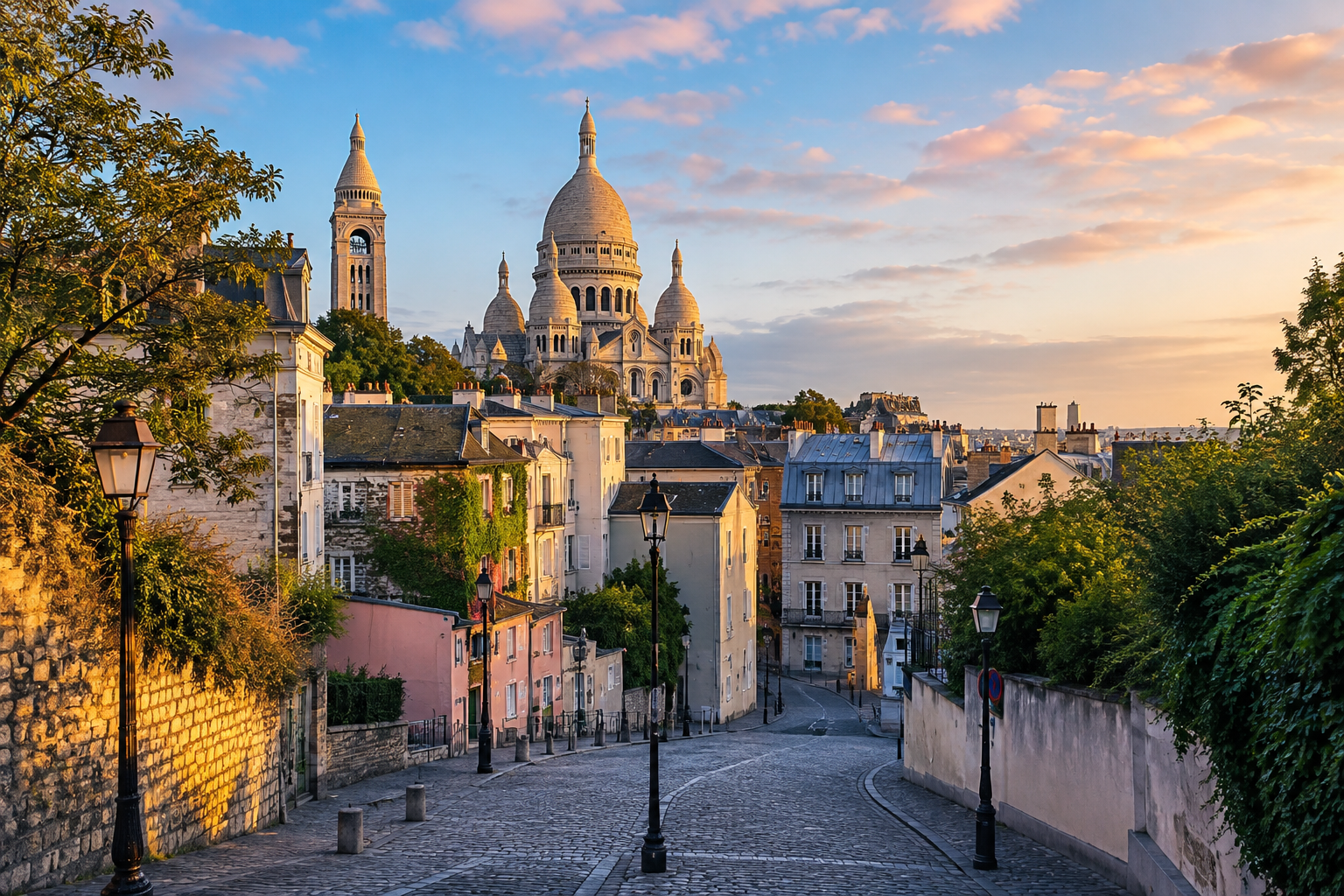
Montmartre Walking Tour: A Self-Guided Route Through Paris
Montmartre is one of those places in Paris that is best discovered on foot. Its steep streets, hidden stairways, artists’ squares and unexpected viewpoints make wandering through the neighborhood part of the experience itself.
This Montmartre walking tour is designed for travelers who want to explore independently rather than follow a large organized group. The route connects some of the neighborhood’s most famous landmarks with quieter streets and small details that are easy to miss when you simply head straight to Sacré-Cœur.
Allow around 2–3 hours for the complete walk. You can easily make it longer by stopping for coffee, exploring the shops or spending more time around Sacré-Cœur.
Montmartre Walking Tour: Route at a Glance
This self-guided route takes you through approximately 3–4 kilometers of one of the most distinctive neighborhoods in Paris.
Suggested route:
- Blanche and the Moulin Rouge
- Café des Deux Moulins
- Rue Lepic
- Moulin de la Galette
- La Maison Rose
- Clos Montmartre vineyard
- Place du Tertre
- Sacré-Cœur
- Square Marcel Bleustein Blanchet
- Rue des Abbesses
You don’t need to rush. Montmartre rewards curiosity, so leave yourself time to take small detours whenever an interesting street catches your attention.
1. Start at Blanche and the Moulin Rouge
A convenient starting point for this Montmartre walking tour is Blanche Métro station on Line 2.
As soon as you leave the station, you will see one of the most recognizable landmarks in Paris: the red windmill of the Moulin Rouge.
The famous cabaret opened in 1889, during a period when Montmartre was becoming known for nightlife, artists and entertainment. Painters, performers and writers were attracted to an area that felt very different from the more formal center of Paris.
You don’t need to attend a show to appreciate the building. Take a look at the façade, then begin climbing Rue Lepic into Montmartre.
2. Walk Up Rue Lepic
Rue Lepic gives you an immediate taste of the neighborhood.
Instead of heading directly toward Sacré-Cœur, follow the street as it curves uphill. You’ll pass cafés, bakeries, small shops and traditional Parisian buildings.
Film fans may want to make a short stop at Café des Deux Moulins, which became famous as one of the locations used in the movie Amélie.
Continue uphill and you’ll gradually leave the busiest streets behind.
This is one of the pleasures of exploring Montmartre on foot: just a few minutes can separate a crowded avenue from a surprisingly peaceful residential street.
3. Discover the Moulin de la Galette
Continue toward the Moulin de la Galette, one of the surviving windmills that remind visitors of Montmartre’s rural past.
Before becoming part of Paris, the hill was dotted with vineyards, fields and windmills used to grind grain and press grapes.
The Moulin de la Galette later became a popular place for dancing and entertainment.
It was immortalized by Pierre-Auguste Renoir in his famous painting Bal du moulin de la Galette, now displayed at the Musée d’Orsay.
If you plan to visit the museum during your trip, seeing the location before encountering Renoir’s painting creates a fascinating connection between modern Paris and the city represented by the Impressionists.
Turn Your Paris Museum Visit Into an Adventure
Exploring the artistic side of Paris? Continue the experience inside the Louvre or Musée d’Orsay with an interactive museum adventure. Follow a story, search for hidden details and solve challenges — at your own pace, with no guide and no fixed schedule.
4. Continue to La Maison Rose
From here, make your way toward La Maison Rose.
The small pink building on the corner of Rue de l’Abreuvoir has become one of the most photographed spots in Montmartre.
But don’t concentrate only on the building. Look around.
Rue de l’Abreuvoir itself is one of the most attractive streets in the neighborhood, particularly when viewed looking uphill.
This section of the walk is a good place to slow down. Montmartre is much more enjoyable when you treat the streets themselves as attractions rather than simply moving from monument to monument.
5. Find Montmartre’s Vineyard
Just a short walk away is something many first-time visitors don’t expect to find in central Paris: a vineyard.
Clos Montmartre preserves the neighborhood’s centuries-old connection with winemaking.
The vineyard is small and normally viewed from outside, but its existence reveals how different Montmartre once was.
Until the nineteenth century, this area stood outside the city limits and retained a much more rural character than central Paris.
This is exactly why a walking tour of Montmartre can be more interesting than simply visiting Sacré-Cœur. The streets reveal layers of history that aren’t obvious from the major monuments alone.
6. Walk Toward Place du Tertre
Continue toward Place du Tertre, the famous artists’ square.
Artists still set up their easels here to paint portraits, caricatures and Parisian scenes.
The square reflects Montmartre’s long association with art. During the late nineteenth and early twentieth centuries, artists including Picasso, Modigliani, Renoir and Utrillo lived or worked around the neighborhood.
Today Place du Tertre is extremely popular with visitors, so don’t expect a quiet hidden square.
If it feels too crowded, spend a few minutes exploring the surrounding side streets instead. Often, walking only one or two streets away dramatically changes the atmosphere.
7. Reach Sacré-Cœur
Now continue toward the most famous landmark on the hill: the Basilica of Sacré-Cœur.
Its white domes dominate the skyline of northern Paris and can be seen from many parts of the city.
The basilica was constructed between the late nineteenth and early twentieth centuries and stands close to the highest natural point in Paris.
Before going inside, walk toward the terrace in front of the basilica.
This is one of the best-known viewpoints in Paris. On a clear day, the city stretches out below you in almost every direction.
A Small Tip for Visiting Sacré-Cœur
The steps directly below the basilica are usually one of the busiest parts of Montmartre.
If you want a quieter moment, walk around the sides and behind Sacré-Cœur. Within minutes, the crowds become noticeably thinner.
8. Explore the Streets Behind Sacré-Cœur
Many visitors reach Sacré-Cœur, admire the view and immediately head back down the hill.
Don’t.
Some of the most enjoyable streets on a Paris Montmartre walking tour are found around and behind the basilica.
Take a short detour through Square Marcel Bleustein Blanchet, then wander through the surrounding streets.
This part of the route gives you another perspective on Montmartre: less like a major Paris attraction and more like a neighborhood where people actually live.
It is also a good place to stop for a few minutes before beginning the descent.
9. Walk Down Toward Abbesses
Instead of returning via the main staircase below Sacré-Cœur, make your way toward Rue des Abbesses.
The descent takes you through another lively part of Montmartre filled with cafés, shops and restaurants.
Near Abbesses Métro station you’ll also find the Wall of Love — Le Mur des Je t’aime — where the words “I love you” appear hundreds of times in different languages.
It’s a fun final stop before finishing the route at Abbesses station.
Montmartre Walking Tour Map: How to Follow the Route
You don’t need a specialist guide to complete this route.
For a simple Montmartre walking tour map, save the stops above in Google Maps before starting:
Blanche → Moulin Rouge → Rue Lepic → Moulin de la Galette → La Maison Rose → Clos Montmartre → Place du Tertre → Sacré-Cœur → Square Marcel Bleustein Blanchet → Abbesses
Don’t worry about following the route meter by meter.
Part of the appeal of Montmartre is getting slightly lost. If you see an interesting staircase, alley or viewpoint, explore it and then return to the general route.
How Long Does a Montmartre Walking Tour Take?
Plan approximately 2–3 hours.
You could technically walk between the main stops much faster, but that defeats the purpose.
Allow extra time if you want to:
- enter Sacré-Cœur
- stop at a café
- have lunch in Montmartre
- take photographs
- browse shops
- watch the artists around Place du Tertre
- explore side streets
Families visiting with children or teenagers may also prefer a slower pace with more frequent stops.
Is Montmartre Difficult to Walk?
Montmartre is built on a hill, so expect slopes, stairs and uneven streets.
Comfortable shoes are highly recommended.
The route described here climbs gradually from Blanche toward the top of Montmartre and then descends toward Abbesses.
If steep climbs are difficult for you, the Montmartre funicular can eliminate part of the climb near Sacré-Cœur, although you’ll miss some of the streets that make exploring the neighborhood enjoyable.
When Is the Best Time for a Montmartre Walking Tour?
Early morning is the best option if you want quieter streets and easier photographs.
Late afternoon and early evening create a livelier atmosphere and can be particularly attractive around sunset.
The busiest period is generally around the middle of the day, especially near Sacré-Cœur and Place du Tertre.
If possible, start before the largest crowds arrive and take your time exploring the quieter sections of the route.
Is a Self-Guided Montmartre Walking Tour Worth It?
Absolutely.
Montmartre is particularly suitable for independent exploration because many of its attractions are concentrated within a relatively small area.
A Montmartre self guided walking tour also gives you something an organized tour cannot always offer: freedom.
You can spend twenty minutes photographing one street, stop unexpectedly at a bakery or completely change direction because you’ve spotted an interesting staircase.
And in Montmartre, those unplanned moments are often the best part of the visit.
Turn Exploring Paris Into a Game
If you enjoy discovering places independently, you can use the same idea inside some of Paris’s most famous museums.
Instead of simply walking from artwork to artwork, Escape The Museum turns a museum visit into a self-guided challenge filled with clues and puzzles.
Planning to visit the Louvre or Musée d’Orsay during your Paris trip?
Discover our Paris museum adventures and turn your next museum visit into a game.
Continue Exploring Paris
Montmartre can easily be combined with other independent routes and activities around the city.
If you’re planning the rest of your trip, you may also enjoy:
- Self-Guided Walking Tour of Paris: Explore the City at Your Own Pace
- Paris in One Day: The Perfect Itinerary for First-Time Visitors
- 15 Unusual Things to Do in Paris Beyond the Usual Sights
- Things to Do in Paris with Teenagers: A Complete Family Guide
Exploring Paris doesn’t have to mean rushing between famous monuments.
Sometimes the best way to discover the city is simply to choose a neighborhood, start walking and see where the streets take you.
Turn Your Paris Museum Visit Into an Adventure
Visiting the Louvre or Musée d’Orsay? Explore the masterpieces in a different way. Follow the story, look for hidden details and solve challenges as you make your way through the museum — at your own pace, with no guide and no fixed schedule.