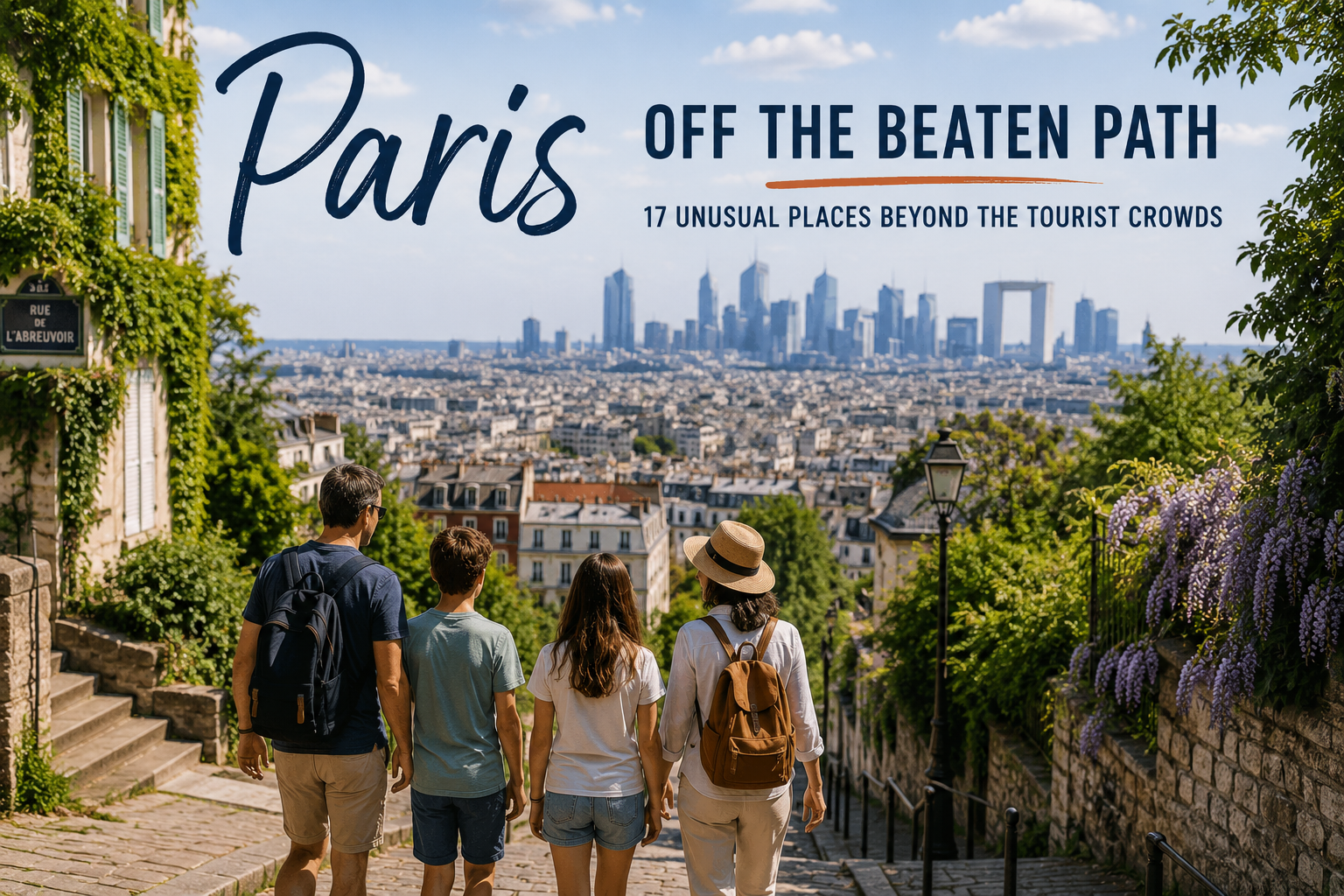
Paris Off the Beaten Path: 17 Unusual Places Beyond the Tourist Crowds
The Eiffel Tower, the Louvre and Notre-Dame belong on almost every first trip to Paris. But some of the most memorable moments in the city happen when you stop following the classic sightseeing route.
Exploring Paris off the beaten path means wandering beyond the famous monuments and discovering neighborhoods, hidden gardens, unusual museums, old railway lines and streets where everyday Parisian life is still part of the experience.
You do not have to travel to the outskirts of the city or deliberately avoid everything popular. Sometimes an unexpected place is only a few streets away from one of Paris’s busiest attractions.
This guide takes you through 17 places and experiences that reveal a different side of Paris, from quiet corners of Montmartre to forgotten railway tracks and lesser-known museums.
If you enjoyed our guide to unusual things to do in Paris, think of this as the next step: moving away from individual unusual attractions and exploring the city itself differently.
1. Explore the Other Side of Montmartre
Montmartre is hardly a secret.
Millions of visitors climb towards Sacré-Cœur every year, and Place du Tertre can be one of the busiest places in northern Paris.
But walk beyond these famous spots and Montmartre changes surprisingly quickly.
Instead of immediately heading back towards the center, continue exploring the streets around Lamarck-Caulaincourt.
Look for quiet staircases, small houses and streets that reveal traces of the neighborhood Montmartre was before tourism became such an important part of it.
Rue de l’Abreuvoir is one of the most photographed streets in the area, but there are plenty of less obvious corners nearby.
Explore Montmartre rather than simply visiting it
The best way to experience this part of Paris is without rushing.
Instead of creating a route that moves from attraction to attraction, give yourself time to notice details between them.
Old signs, unusual façades, steep staircases and unexpected views become part of the experience.
Montmartre is particularly well suited to self-guided exploration because the neighborhood itself tells a story as you walk.
It is also why we see Montmartre as an ideal place to combine walking, history and small challenges: a way of discovering the neighborhood rather than simply passing through it.
2. Walk Along the Petite Ceinture
For decades, a railway circled Paris.
The Petite Ceinture, or Little Belt, was constructed during the 19th century and once carried passengers and goods around the city.
As other forms of transport developed, the railway gradually lost its original importance.
Today, parts of the old line have been transformed into public walking areas.
The result is one of the most interesting places to experience Paris off the beaten track.
Old railway infrastructure sits beside trees and wild vegetation. Bridges, tunnels and abandoned tracks provide glimpses of another layer of the city’s history.
Different sections of the Petite Ceinture have different access arrangements, so check current information before choosing where to explore.
It is not a single attraction with an entrance, ticket and prescribed route.
That is precisely what makes it interesting.
3. Discover La Campagne à Paris
There are parts of Paris that barely look like Paris.
La Campagne à Paris, in the 20th arrondissement, is one of them.
This small residential area was developed in the early 20th century and is characterized by rows of houses rather than the apartment buildings that dominate much of the capital.
Climb the streets and stairways and you will find greenery, individual homes and a surprisingly peaceful atmosphere.
It feels more like a small town inserted into Paris than a neighborhood within one of Europe’s largest cities.
There is no major monument here.
No museum.
No attraction you need to queue for.
The pleasure comes simply from walking through somewhere unexpected.
Remember that this is a residential neighborhood. Explore quietly and respect the people who live there.
4. Find the Butte Bergeyre
Not far from the much better-known Parc des Buttes-Chaumont lies another small elevated neighborhood.
The Butte Bergeyre sits on a hill in the 19th arrondissement and can be reached via steep streets and staircases.
At the top, you find a pocket of Paris that feels remarkably removed from the busy city below.
There are houses, greenery and even a small vineyard.
You can also find unexpected views towards Montmartre.
Butte Bergeyre is exactly the type of place that makes exploring alternative Paris rewarding.
There is not necessarily something spectacular waiting for you when you arrive.
Instead, the journey, atmosphere and contrast with surrounding streets create the experience.
5. Wander Through Buttes-Chaumont
The Jardin du Luxembourg and Tuileries Garden are beautiful, but Paris has other green spaces with completely different personalities.
Parc des Buttes-Chaumont is one of the best.
Built on the site of former quarries, the park has dramatic changes in elevation, bridges, cliffs, paths and viewpoints.
Its landscape feels much less formal than many central Parisian gardens.
Walk around the lake, climb towards the higher viewpoints and explore the smaller paths rather than simply crossing the park.
It is particularly enjoyable when you need a break from museums and monuments.
Combine it with nearby neighborhoods such as Belleville or the Butte Bergeyre and you can create an entire half-day away from the traditional tourist center.
6. Search for Street Art in the 13th Arrondissement
The grand façades of central Paris create one of the world’s most recognizable urban landscapes.
The 13th arrondissement shows you something different.
Large-scale murals cover the sides of buildings, turning ordinary residential streets into an enormous open-air gallery.
Some works occupy several floors.
Others appear unexpectedly as you walk.
Create your own street-art hunt
Instead of following a rigid itinerary, make the murals the objective.
Walk, search and photograph the pieces you like most.
If you are traveling with teenagers, let everyone choose a favorite and compare them at the end.
This simple approach transforms an ordinary neighborhood walk into a small urban challenge.
It also encourages you to explore parts of Paris you might never visit if your itinerary consisted only of famous monuments.
7. Step Into the Village of Mouzaïa
Another unexpected residential corner can be found close to Buttes-Chaumont.
Around Rue de Mouzaïa, narrow pedestrian lanes lined with small houses create an atmosphere far removed from the boulevards of central Paris.
These lanes — known as villas — were developed for workers during the 19th century.
Today they form one of the city’s most distinctive residential areas.
Walk slowly through the neighborhood and enjoy the contrast.
Again, this is someone’s home rather than a conventional attraction.
Do not treat doors, gardens or windows as photography sets.
The goal of exploring less touristy places should be to experience another side of the city respectfully.
8. Discover the Musée de la Vie Romantique
At the foot of Montmartre sits a small museum that many visitors walk straight past.
The Musée de la Vie Romantique occupies a historic house associated with the artistic life of 19th-century Paris.
The scale is part of its appeal.
After visiting enormous institutions such as the Louvre, entering a small house museum provides a completely different cultural experience.
The building, courtyard and garden contribute as much to the atmosphere as the collection itself.
It is a useful reminder that Parisian culture does not exist only inside its world-famous museums.
Smaller institutions often provide more intimate connections with particular periods, artists and stories.
Make Your Paris Museum Visit Part of the Adventure
Exploring Paris beyond the usual tourist route? You can bring the same spirit of discovery inside the Louvre or Musée d’Orsay. Follow a story, search for hidden details and solve challenges — at your own pace, with no guide and no fixed schedule.
9. Follow Canal Saint-Martin
The Seine dominates the image most travelers have of Parisian waterways.
For something different, follow the Canal Saint-Martin.
Its locks, iron footbridges and tree-lined banks create a much more relaxed atmosphere than many central areas.
You can walk alongside the water, stop at nearby cafés or simply watch boats navigate the locks.
There is no need to complete the entire canal.
Choose a section and let the walk unfold naturally.
Canal Saint-Martin works particularly well late in the afternoon, when you have already spent several hours visiting attractions and want something less structured.
Sometimes going off the beaten path in Paris is not about finding a secret attraction.
It is about changing pace.
10. Explore Belleville
Belleville is one of the most interesting neighborhoods for travelers who want to see a different side of contemporary Paris.
Historically working-class and shaped by successive waves of immigration, the area has a cultural identity very different from the monumental center.
Street art, independent businesses and a mixture of architectural styles make wandering here interesting.
Head towards Parc de Belleville for one of the area’s best views.
From elevated sections of the park, the Paris skyline opens in front of you.
Look at the neighborhood, not just the viewpoint
Do not visit only to photograph the panorama.
Walk the surrounding streets.
Look at shops, murals, cafés and everyday neighborhood life.
This is where exploring Paris independently becomes especially rewarding.
There is no compulsory attraction.
You decide what catches your attention.
11. Find the Arènes de Lutèce
In the heart of the Latin Quarter lies evidence of a much older Paris.
The Arènes de Lutèce are remains of a Roman amphitheater built when Paris was still Lutetia.
What makes the site fascinating is not simply its age.
It is its location.
Modern apartment buildings surround a space connected to a city that existed almost two thousand years ago.
Many travelers explore the Latin Quarter without realizing it is there.
That makes the arena an excellent small detour when visiting this part of Paris.
Combine it with nearby streets rather than making it a standalone destination.
One of the pleasures of exploring hidden Paris is discovering layers of history embedded inside the modern city.
12. Walk the Coulée Verte René-Dumont
An abandoned railway was transformed into an elevated green walkway through eastern Paris long before New York created the High Line.
The result is the Coulée Verte René-Dumont, also known as the Promenade Plantée.
The route changes character as you walk.
Some sections are elevated above streets, giving unusual views into surrounding buildings.
Others pass through greener areas or former railway infrastructure.
Walking here provides a completely different perspective on Paris.
Instead of looking up at monuments, you look across rooftops, balconies and ordinary streets.
It is a particularly good choice if you enjoy walking and want to combine urban history with green space.
13. Explore the Covered Passages Beyond Galerie Vivienne
Paris’s covered passages are becoming increasingly popular, but most visitors see only one or two.
Galerie Vivienne is beautiful, but continue exploring.
Passage des Panoramas, Passage Jouffroy and Passage Verdeau can be connected into a longer walk.
Along the way you will find old shops, book dealers, restaurants and architectural details dating from another era of Parisian life.
Turn several passages into one route
Rather than treating each arcade as a separate attraction, connect them.
The walk between passages becomes part of the experience.
This is also a good activity for rainy weather because substantial parts of the route are protected.
For travelers interested in history, architecture and unusual shopping environments, the passages offer an accessible introduction to a less obvious Paris.
14. Visit Père Lachaise Beyond the Famous Graves
Père Lachaise is famous for the people buried there.
Oscar Wilde, Jim Morrison, Édith Piaf and Frédéric Chopin attract visitors from around the world.
But the cemetery becomes more interesting when you stop treating it as a list of famous graves.
Explore the smaller paths.
Look at the sculptures, family tombs, chapels and inscriptions.
Some monuments are beautiful.
Others are strange, dramatic or deeply personal.
The enormous cemetery feels almost like a separate city.
Give yourself a few graves to find, but leave time to wander between them.
Having something to search for adds purpose to the walk without preventing unexpected discoveries.
15. Discover the Quiet Side of Le Marais
Le Marais is one of Paris’s most visited neighborhoods, so including it in an article about Paris off the beaten path might seem strange.
But even popular neighborhoods contain quieter layers.
Move beyond Rue des Rosiers and Place des Vosges.
Look for small courtyards, historic mansions and side streets.
Slow down enough to notice doors, plaques and architectural details.
This distinction is important.
Exploring alternative Paris does not always require traveling somewhere obscure.
Sometimes it simply means exploring a familiar place more carefully.
Le Marais rewards exactly that approach.
16. Walk Through the Jardin des Plantes and Its Surroundings
The Jardin des Plantes is well known, but it often receives less attention from first-time visitors than Paris’s most famous central gardens.
Its botanical collections, long avenues and surrounding scientific institutions create a different atmosphere.
It also sits in an excellent area for walking.
Combine the gardens with the Arènes de Lutèce and nearby Latin Quarter streets to create a route that mixes nature, Roman history and everyday Paris.
Rather than jumping between attractions by Metro, connecting nearby places on foot reveals how the city fits together.
That principle is central to exploring Paris beyond the standard tourist itinerary.
17. Choose a Neighborhood and Explore Without a Checklist
The final recommendation is not a place.
It is a method.
Choose a neighborhood, put away the list of must-see attractions for an hour and walk.
Give yourself only a loose objective.
Find an interesting café.
Look for unusual architecture.
Photograph three details you would normally ignore.
Find the oldest-looking building.
Follow a street simply because it looks interesting.
Turn the city into a game
If you are traveling as a family, create a small challenge.
Who can find:
- an unusual door?
- a hidden garden?
- a piece of street art?
- an old shop sign?
- a building with a date carved into it?
- an unexpected view?
- a tiny passage?
- something connected to Parisian history?
Suddenly, nobody is simply following the itinerary.
Everyone is exploring.
This is one of the simplest ways to experience Paris off the beaten path with teenagers or children because the journey itself becomes the activity.
How to Explore Paris Off the Beaten Path
Finding a different Paris does not require secret knowledge.
It requires a slightly different approach to planning.
Walk more
Paris has an excellent public transport system, but taking the Metro between every attraction removes everything that exists between those attractions.
When distances are reasonable, walk.
A twenty-minute journey can reveal a market, courtyard, unusual building or café you would otherwise never know existed.
Explore neighborhoods, not just attractions
Instead of planning:
Louvre → Eiffel Tower → Arc de Triomphe,
try dedicating part of the day to one area.
Montmartre, Belleville, Le Marais and the Latin Quarter all reward slower exploration.
You will see fewer headline attractions but understand more about how different parts of Paris feel.
Leave empty space in your itinerary
An itinerary planned in thirty-minute blocks leaves no room for discovery.
Do not be afraid of having an afternoon with only one or two fixed objectives.
The empty spaces are where unexpected Paris often appears.
Look carefully
Some of the city’s most interesting details are small.
Plaques explain historical events.
Old advertisements remain painted on walls.
Architectural details reveal how buildings were once used.
Tiny mosaics and pieces of street art appear where you least expect them.
The slower you move, the more Paris reveals.
Paris Off the Beaten Path With Teenagers
Traveling with teenagers can actually make alternative Paris more interesting.
Instead of asking them to appreciate another monument simply because it is historically important, give them something active to do.
Search for street art.
Navigate part of the route.
Choose the next place.
Photograph unusual details.
Solve clues.
Find hidden locations.
This gives teenagers a role in the experience rather than making them passive participants in someone else’s itinerary.
The same principle works inside museums.
Instead of trying to see every gallery, turn observation into part of the activity.
Our Louvre and Musée d’Orsay museum games were created around this idea: use stories and challenges to encourage visitors to look more closely at the artworks and spaces around them.
Culture does not have to disappear from a family itinerary.
Sometimes it simply needs a different approach.
Can You Still Visit the Famous Sights?
Absolutely.
Going off the beaten path does not mean avoiding the Eiffel Tower because other tourists want to see it.
It does not mean skipping the Louvre.
And it certainly does not mean spending your holiday trying to prove that you know places nobody else has discovered.
Paris’s major monuments are extraordinary.
Visit them.
Then add contrast.
Spend the morning at the Louvre and the afternoon walking beside Canal Saint-Martin.
See Sacré-Cœur and then explore the quieter side of Montmartre.
Visit Notre-Dame before looking for Roman Paris at the Arènes de Lutèce.
The combination often produces a better trip than either approach alone.
Build Your Own Alternative Paris Itinerary
If you want to dedicate a day to a different side of Paris, keep the route geographically sensible.
For example:
Morning — Northeast Paris
Start around Buttes-Chaumont.
Explore the park before walking through nearby residential streets such as Mouzaïa or climbing towards Butte Bergeyre.
Lunch — Belleville
Continue towards Belleville and find somewhere to eat in the neighborhood.
Walk through the surrounding streets and look for street art before visiting Parc de Belleville.
Afternoon — Canal Saint-Martin
Move towards Canal Saint-Martin and slow the pace.
Follow the water, cross the footbridges and watch the locks.
Evening — Explore without a plan
Choose somewhere nearby for dinner and walk the surrounding streets.
Do not add another major attraction simply because there is an empty hour.
Allow the city to become the attraction.
From Alternative Paris to Self-Guided Exploration
Once you stop treating Paris as a checklist of monuments, another way of traveling becomes possible.
You can explore neighborhoods through stories.
Follow routes independently.
Search for details.
Discover historical clues.
Solve challenges.
And experience the city at your own pace rather than following a group.
This is where self-guided walking tours and city games become particularly interesting.
They sit somewhere between a traditional guided tour and wandering without any context.
You still have a route and a reason to pay attention, but you decide how quickly you move, when you stop and what interests you most.
Montmartre is especially suited to this type of exploration because its streets contain layers of artistic history, unusual characters and small details that are easy to miss when you simply walk from the Metro to Sacré-Cœur.
We will be exploring this way of discovering Paris much more deeply in our upcoming guides.
Discover Paris Differently
The best Paris off the beaten path experiences are not necessarily the most secret ones.
They are the experiences that change the way you interact with the city.
Walk instead of rushing underground.
Explore a neighborhood instead of collecting monuments.
Look for details.
Follow stories.
Give yourself something to find or solve.
And when you visit one of Paris’s great museums, you can use exactly the same approach.
At Escape The Museum, our self-guided Louvre and Musée d’Orsay games turn museum visits into interactive adventures built around observation, stories and challenges.
You explore at your own pace, with no guide and no fixed schedule.
Turn Your Paris Museum Visit Into an Adventure
Visiting the Louvre or Musée d’Orsay? Explore the masterpieces in a different way. Follow the story, look for hidden details and solve challenges as you make your way through the museum — at your own pace, with no guide and no fixed schedule.