Non-Touristy Things to Do in Paris: 17 Ways to Experience Paris Like a Local
Paris has some of the most famous attractions in the world. The Eiffel Tower, the Louvre, Notre-Dame and Montmartre attract millions of visitors for very good reasons.
But what happens when you want to experience the city beyond its sightseeing checklist?
Finding non-touristy things to do in Paris does not necessarily mean searching for places nobody else knows. In a city this popular, genuinely secret places rarely stay secret for long.
A better approach is to change the way you experience Paris.
Spend a morning at a neighborhood market. Walk beside a canal instead of rushing between monuments. Explore residential streets. Have a picnic. Visit a small museum. Sit at a café without immediately planning your next attraction.
This guide focuses on 17 ways to experience a more local side of Paris while still enjoying the city you came to see.
You do not have to avoid the Eiffel Tower or skip the Louvre.
Simply leave enough space between the famous sights to experience everyday Paris too.
1. Start Your Morning at a Parisian Market
One of the easiest ways to move away from the traditional tourist experience is to visit a neighborhood market.
Markets are part of everyday Parisian life rather than attractions created specifically for visitors.
Depending on the market, you may find fruit, vegetables, cheese, bread, flowers, prepared food and products from communities that have shaped modern Paris.
The experience is simple.
Walk.
Look.
Buy something that interests you.
Listen to the conversations around you.
Make the market part of your day
Do not visit simply to photograph the stalls.
Buy fruit for later, choose some cheese or pick up ingredients for a picnic.
This immediately changes your relationship with the place.
Instead of observing Parisian life, you participate in a small part of it.
Different markets operate on different days and schedules, so check current opening information before building one into your itinerary.
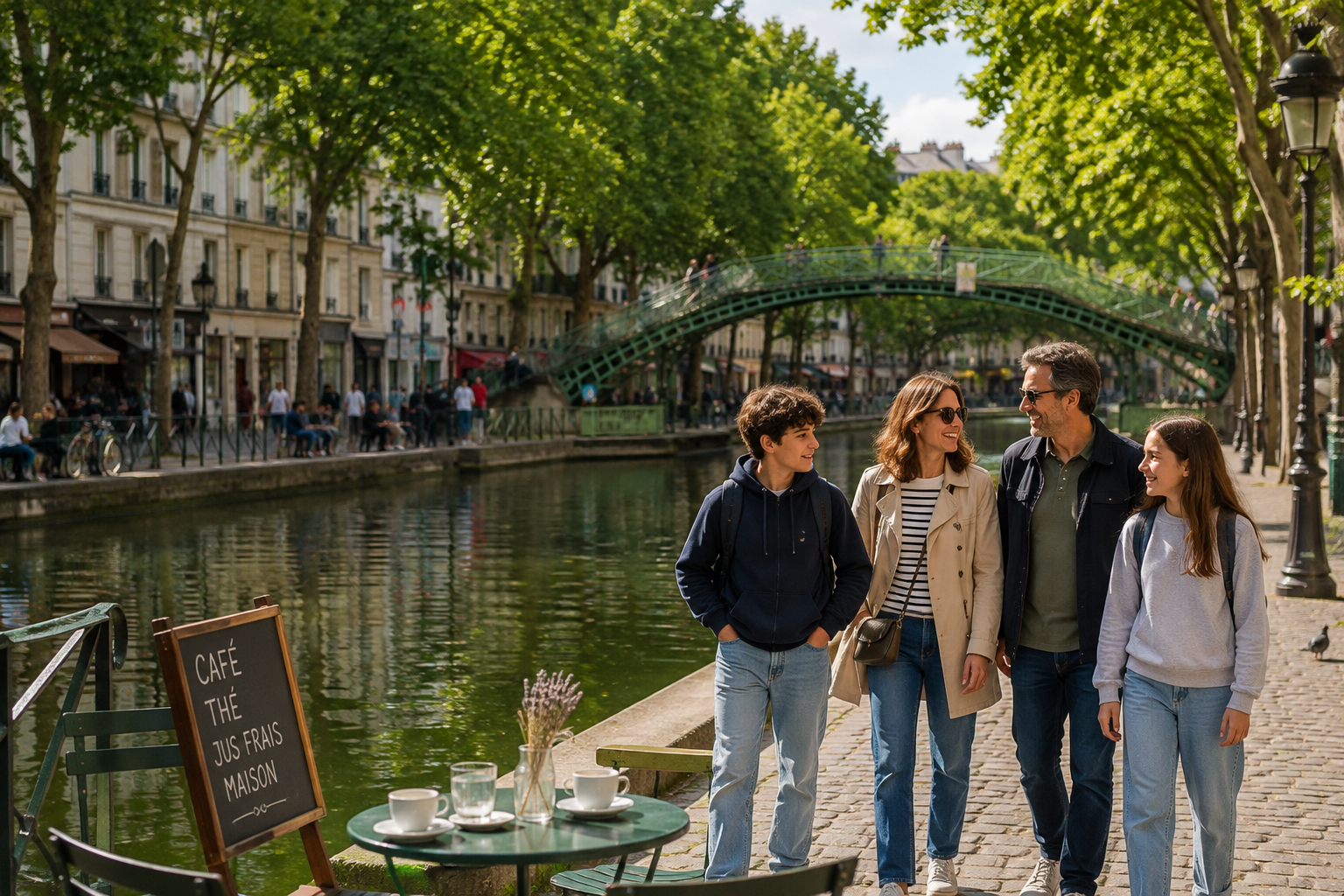
2. Follow Canal Saint-Martin Without a Destination
The Seine is magnificent, but it does not have to be your only waterside walk in Paris.
Canal Saint-Martin offers a completely different atmosphere.
Iron footbridges cross the water. Boats move through locks. Trees line sections of the canal, and surrounding streets contain cafés, shops and places to stop.
The best way to experience it is without making the walk another checklist.
Choose a starting point and follow the canal.
Cross a bridge because you like the look of the other side.
Stop when something interests you.
Sit beside the water.
Have a coffee.
Slow travel in the middle of a major city
This is what makes Canal Saint-Martin particularly useful for travelers searching for less touristy things to do in Paris.
Nothing dramatic has to happen.
You are simply experiencing a part of the city at a slower pace.
After several hours of museums and monuments, that can feel surprisingly refreshing.
3. Have a Picnic Instead of Another Restaurant Meal
Paris has extraordinary restaurants, and eating well should absolutely be part of your visit.
But not every meal needs a reservation.
Visit a bakery, market or local food shop and create your own picnic.
Bread, cheese, fruit and something sweet are enough.
Then find somewhere pleasant to sit.
Depending on your route, this might be beside the Seine, in a park or somewhere along a canal.
Why a picnic changes the experience
A picnic gives you something that tightly scheduled sightseeing often removes:
time.
Nobody needs to bring the bill.
Nobody is waiting for your table.
You can sit, talk and watch Paris around you.
For families, it also provides a welcome break during a long day of walking.
And children or teenagers can help choose what everyone eats.
Simple experiences often become some of the most memorable moments of a trip.
4. Explore a Neighborhood Without Chasing Attractions
Choose one Paris neighborhood and give yourself an hour with no list of monuments.
This can feel strangely difficult if you normally plan trips around Google Maps pins.
Try it anyway.
Le Marais, the Latin Quarter, Montmartre, Batignolles or another neighborhood can all work.
The objective is not to find a hidden attraction.
It is to notice the neighborhood.
Look at the shops.
Architecture.
Schools.
Bakeries.
Squares.
Doors.
People going about their day.
Give yourself a small mission
If walking without an objective feels too vague, create one.
Find the most interesting doorway.
Look for an old shop sign.
Find three examples of street art.
Choose your favorite building.
Let someone else in the family decide which street to take at each intersection.
This turns ordinary walking into exploration without requiring a formal tour.
5. Take a Bus Instead of the Metro
The Paris Metro is fast and extremely useful.
It is also underground.
If you use it for every journey, you can spend a surprising amount of your visit moving through tunnels while Paris passes unseen above you.
For some journeys, take a regular city bus instead.
You are not buying a sightseeing tour.
You are simply using public transport like thousands of Parisians do every day.
The journey may take longer, but you see neighborhoods and streets you would otherwise miss.
Use transport as part of the experience
This works particularly well when your feet need a rest.
Find a seat, watch the city and let Paris come to you for a while.
Not every minute needs to involve walking or visiting something.
6. Discover the Village Atmosphere of Butte-aux-Cailles
The Butte-aux-Cailles in the 13th arrondissement provides a contrast with the grand boulevards and monumental architecture of central Paris.
Its smaller streets, low-rise buildings, cafés and street art give parts of the neighborhood an almost village-like atmosphere.
This is somewhere to wander rather than somewhere to complete.
There is no single attraction that justifies the visit.
That is part of the point.
Walk through the streets, look for murals and stop when somewhere appeals to you.
Combine it with other parts of the 13th arrondissement if you want to make the journey worthwhile.
7. Search for Street Art Instead of Masterpieces
You could spend days inside Parisian museums.
But art exists outside them too.
Several areas of Paris are known for street art, particularly parts of the 13th arrondissement and Belleville.
Large murals cover entire sides of buildings.
Smaller works appear on walls, shutters and unexpected surfaces.
Searching for them changes the way you walk.
Instead of moving directly towards an attraction, you begin scanning the streets around you.
Make it competitive
Traveling with teenagers?
Give everyone twenty minutes to photograph the most interesting piece they can find.
Compare the results afterwards.
There is no correct answer and no cultural knowledge required.
Everyone simply has to look.
This is one of the easiest ways to turn a neighborhood into an activity.
8. Spend Time in Parc des Buttes-Chaumont
Central Paris has famous formal gardens such as the Tuileries and Luxembourg Gardens.
Parc des Buttes-Chaumont feels very different.
Created on former quarry land, it contains steep slopes, winding paths, bridges and dramatic changes in elevation.
Walk rather than simply finding a bench near the entrance.
Climb towards the viewpoints.
Follow smaller paths.
Spend some time somewhere green without feeling that you need to photograph a famous monument.
You can combine the park with Belleville or other northeastern neighborhoods for a half-day that feels very different from central Paris.
9. Sit at a Café and Do Absolutely Nothing
This may be the hardest recommendation in the entire article.
Sit down.
Order something.
And do not immediately open your itinerary.
Parisian cafés are not secret, obviously.
But there is a difference between stopping for caffeine on the way to an attraction and allowing the café itself to become part of your experience.
Watch the street.
Talk.
Read.
Plan the rest of the day only when you feel like it.
Stop measuring your trip by attractions
Travel can become strangely competitive.
How many things did you see?
How many museums?
How many famous places?
But memories do not work that way.
You may remember forty quiet minutes at a café more clearly than the fifth monument you rushed through that afternoon.
10. Visit a Smaller Paris Museum
The Louvre and Musée d’Orsay deserve their international reputations.
But they are not the only museums in Paris.
Smaller museums can offer something the major institutions struggle to provide: intimacy.
Instead of spending hours navigating enormous collections, you can concentrate on one artist, period, house or story.
Some museums occupy historic homes or unusual buildings, making the setting part of the experience.
Choose according to your interests
Do not visit a museum simply because somebody has described it as a hidden gem.
Look at what it contains.
Does it interest you?
If yes, go.
If not, choose something else.
Experiencing a less touristy Paris should be about following your interests, not replacing one compulsory checklist with another.
11. Buy Bread From a Neighborhood Boulangerie
Buying a baguette sounds too ordinary to appear in a travel guide.
That is exactly why it belongs here.
Find a neighborhood bakery away from the major tourist attractions.
Go inside.
Choose something.
Eat it.
You do not need to identify “the best bakery in Paris.”
In fact, searching for the internet’s number-one croissant can send you straight back into a queue of visitors doing exactly the same thing.
Sometimes the better travel experience is simply finding somewhere that looks good.
If you are staying in an apartment, buying breakfast locally can become a small daily ritual.
12. Walk the Coulée Verte René-Dumont
The Coulée Verte René-Dumont, also known as the Promenade Plantée, follows former railway infrastructure through eastern Paris.
Parts of the route are elevated above street level.
Other sections pass through greener environments and former railway spaces.
It gives you a different perspective on the city.
Instead of concentrating on monuments, you see apartment buildings, balconies, rooftops and ordinary streets from an unusual angle.
It is particularly good for travelers who enjoy walking but want something other than another historic-center route.
There is no need to complete the entire trail.
Choose a section that fits naturally into your day.
13. Explore Paris Early in the Morning
Want to experience a famous part of Paris with a completely different atmosphere?
Get up early.
This does not make a place non-touristy, but it changes your experience of it.
Streets that become crowded later in the day can feel remarkably peaceful in the morning.
Watch cafés prepare for the day.
See delivery vehicles arrive.
Walk beside the Seine before the busiest hours.
Explore a neighborhood while shutters are still opening.
Use your first hour well
You do not need to wake up at 5:00 AM.
Even beginning at 7:30 or 8:00 can make a difference.
Then, when the city becomes busier, move towards neighborhoods and experiences where crowds matter less.
This is particularly useful if you are trying to see Paris in one day.
14. Browse a Bookshop Without Searching for a Souvenir
Paris has a long relationship with books, writers and publishing.
Rather than entering a shop specifically to buy a Paris souvenir, browse because something interests you.
Independent bookshops, specialist stores and second-hand sellers can turn an ordinary walk into a discovery.
Even if you do not speak French fluently, photography, art, architecture and illustrated books can be accessible.
The bouquinistes beside the Seine offer another version of this experience.
Do not feel obliged to buy anything.
Browsing is enough.
15. Explore Belleville Beyond the Viewpoint
Belleville attracts visitors for street art and views across Paris, but the neighborhood deserves more than a quick photograph.
Walk through its streets.
Notice how different it feels from the areas around the Louvre or Eiffel Tower.
Look at independent businesses, restaurants, murals and the mixture of architectural styles.
Paris is not culturally uniform.
Neighborhoods have been shaped by different communities and different histories.
Exploring areas such as Belleville helps reveal a more complex city than the Paris represented on postcards.
Remember that neighborhoods are not attractions
This matters.
People live here.
Do not photograph residents without permission or treat shops and homes as scenery.
The aim is to experience another part of Paris respectfully.
16. Let Teenagers Plan Part of the Day
If you are visiting Paris as a family, one of the most effective ways to escape the standard tourist routine is simple:
give up some control.
Let your teenager choose an activity.
Or a neighborhood.
Or lunch.
Or the route between two places.
Adults often create family itineraries and then wonder why teenagers seem disengaged.
Participation changes that.
Turn exploration into a challenge
Another option is to create a small scavenger hunt.
During the day, find:
- an unusual Metro entrance
- a piece of street art
- a hidden courtyard
- an old shop sign
- a Wallace fountain
- an unexpected view
- a painting containing an animal
- a street musician
You are still sightseeing.
But now everyone has something to do.
This approach also works particularly well inside museums, where searching and solving can transform a passive visit into an active experience.
Make Your Paris Museum Visit Part of the Adventure
Visiting the Louvre or Musée d’Orsay? Our self-guided museum games turn the visit into an interactive challenge for families and teenagers — at your own pace and with no fixed schedule.
17. Leave One Afternoon Unplanned
This may be one of the most genuinely non-touristy things to do in Paris.
Leave space.
No reservation.
No list.
No route that must be completed.
Choose an area and see what happens.
Maybe you discover a market.
Maybe you spend an hour in a park.
Maybe you find a small museum.
Maybe you sit somewhere for much longer than expected.
Maybe nothing remarkable happens at all.
That is fine.
Not every travel moment needs to become content
You do not need to photograph everything.
You do not need to prove that you discovered somewhere hidden.
And you certainly do not need to complete somebody else’s list of “secret Paris.”
Sometimes the best way to experience the city more locally is simply to stop behaving as though every minute needs to justify the cost of your trip.
Non-Touristy Things to Do in Paris vs Paris Off the Beaten Path
These ideas are closely related, but they are not quite the same.
Going off the beaten path in Paris usually means exploring places outside the most conventional tourist routes: lesser-known neighborhoods, unusual walks and locations that receive fewer visitors.
Experiencing non-touristy Paris is broader.
You can have a non-touristy experience even in a famous area.
Buy breakfast from a local bakery near the Louvre.
Take a regular bus through central Paris.
Walk beside the Seine early in the morning.
Sit at a café near Montmartre without rushing to the next attraction.
The location does not always need to be hidden.
Sometimes the difference is simply how you experience it.
Can You Experience a Local Side of Paris on Your First Visit?
Yes — and you should.
There is no reason a first visit has to consist entirely of famous attractions.
The best approach is usually a mixture.
Visit the Eiffel Tower.
See Notre-Dame.
Explore the Louvre if art interests you.
Then create space between those experiences.
Walk.
Eat somewhere you found yourself.
Visit a market.
Explore a neighborhood.
Spend an hour without an objective.
This creates contrast.
And contrast makes the famous attractions feel more special too.
Non-Touristy Things to Do in Paris With Kids
Families do not necessarily need more attractions.
Often they need fewer.
Children can become exhausted by a schedule designed around adult ideas of cultural importance.
Mix major sights with ordinary pleasures.
A playground.
A picnic.
Choosing pastries.
Finding street art.
Taking a bus.
Watching boats pass through a canal lock.
Give children something to find
A simple scavenger hunt works almost anywhere in Paris.
Choose five objects before leaving your accommodation and search for them throughout the day.
Suddenly the journey between attractions becomes part of the entertainment.
This is also an easy way to keep children observing the city rather than asking how long it is until the next stop.
Non-Touristy Things to Do in Paris With Teenagers
Teenagers usually need less supervision and more involvement.
Let them navigate.
Give them choices.
Ask them to photograph the most interesting thing they find.
Explore street art.
Choose somewhere to eat together.
Try a self-guided experience rather than another traditional group tour.
Our guide to things to do in Paris with teenagers goes deeper into ways to make the city engaging for older children.
The key idea is simple:
do not make them passive passengers.
How to Avoid Tourist Traps in Paris
Wanting a more local experience does not mean becoming suspicious of everything popular.
A crowded restaurant is not automatically bad.
A famous attraction is not automatically overrated.
But a few habits help.
Walk one or two streets away
Restaurants and shops immediately beside major attractions often exist primarily because of their location.
Walking a little farther can completely change your options.
Check menus before sitting down
You do not need to analyze hundreds of reviews.
Look at the menu.
Look at prices.
Does it appeal to you?
Make a decision.
Do not chase every viral location
Social media can transform an ordinary street, café or bakery into a destination.
Sometimes it deserves the attention.
Sometimes you spend forty minutes queuing for something available somewhere else without the queue.
Your time in Paris has value too.
How to Build a Less Touristy Day in Paris
Here is one possible structure.
Morning — Market and neighborhood
Start at a local market.
Buy breakfast or picnic supplies.
Spend the rest of the morning exploring the surrounding neighborhood on foot.
Lunch — Picnic
Find a park, canal or other suitable place and eat what you bought earlier.
Slow down.
Afternoon — Walk and discover
Choose an area such as Butte-aux-Cailles, Belleville or the Coulée Verte.
Do not attempt to see all three.
Explore one properly.
Late afternoon — Café
Stop somewhere because you like it, not because it appeared in a “Top 10 Paris Cafés” article.
Evening — Keep it flexible
Walk.
Eat.
Return to somewhere you enjoyed earlier.
Or go and see the Eiffel Tower illuminated.
Remember: experiencing local Paris does not prohibit you from enjoying famous Paris.
You Don’t Need to Choose Between Tourist Paris and Local Paris
There is sometimes a strange pressure around travel to prove that you are not a tourist.
But you are visiting Paris.
You are a tourist.
That is perfectly fine.
The goal is not to pretend you live there.
The goal is to experience more than one version of the city.
Go to the Louvre.
Then visit a neighborhood market.
Photograph the Eiffel Tower.
Then take a regular bus.
Walk through Montmartre.
Then leave the busiest streets behind.
Spend an hour in Musée d’Orsay.
Then spend another hour doing absolutely nothing beside a canal.
The combination creates a richer trip.
Explore Paris Instead of Simply Seeing It
The difference between sightseeing and exploring is often participation.
When you are sightseeing, someone tells you what you should see.
When you are exploring, you have a reason to look.
You search.
Choose.
Walk.
Observe.
Discover.
Sometimes you solve something.
That philosophy is also behind Escape The Museum.
Our self-guided Louvre and Musée d’Orsay games give families, teenagers and curious travelers another way to experience two of Paris’s greatest museums.
Instead of simply moving from famous artwork to famous artwork, you follow a story, look for details and solve challenges along the way.
No group.
No fixed schedule.
Explore at your own pace.
Want to experience Paris differently?
Discover our Paris museum games and turn your next museum visit into part of the adventure.
Turn Your Paris Museum Visit Into an Adventure
Visiting the Louvre or Musée d’Orsay? Explore the masterpieces in a different way. Follow the story, look for hidden details and solve challenges as you make your way through the museum — at your own pace, with no guide and no fixed schedule.