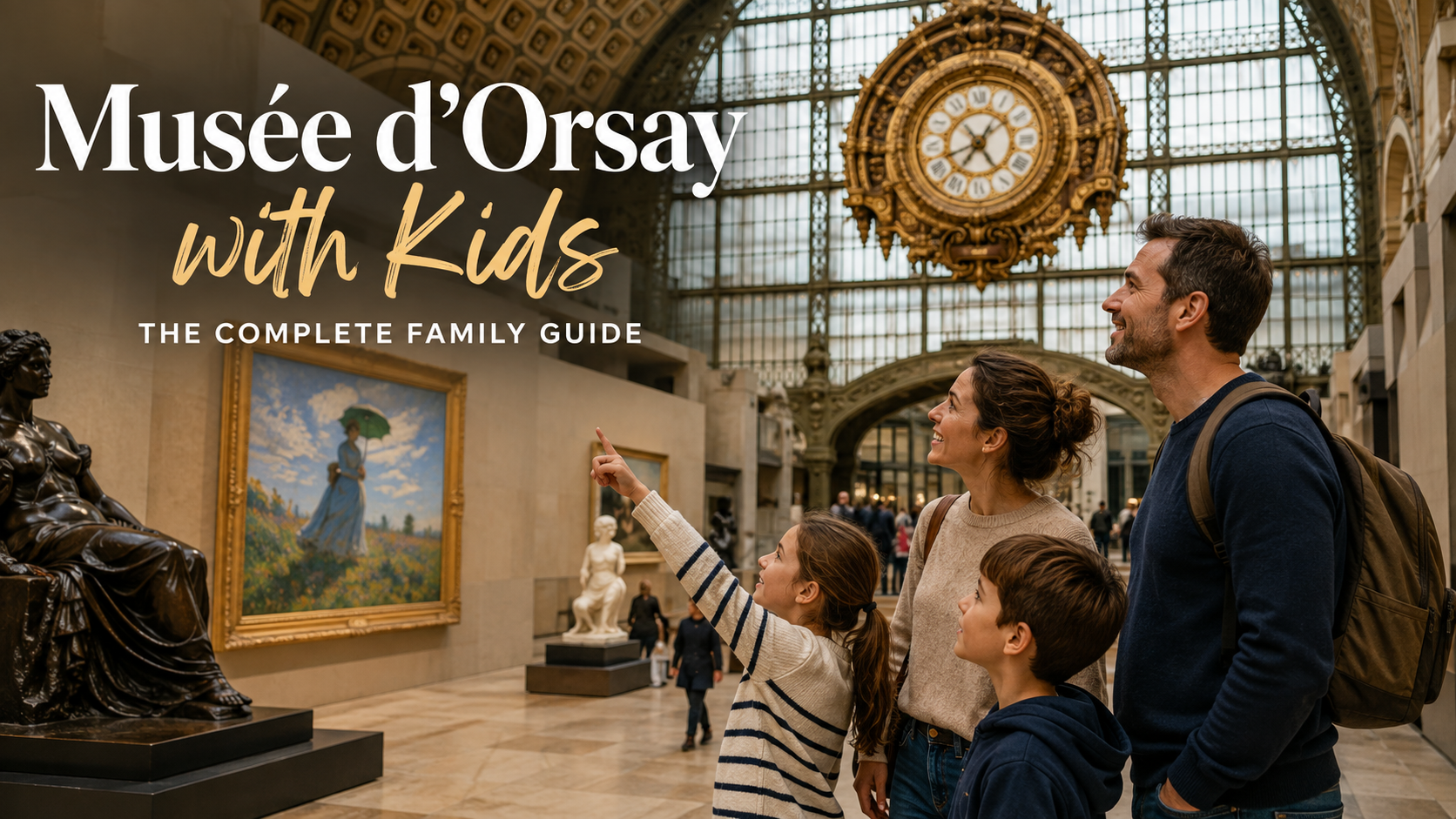
Musée d’Orsay with Kids: The Complete Family Guide
Planning a visit to the Musée d’Orsay with kids? It can be one of the best museum experiences for families in Paris.
Compared with the enormous Louvre, the Musée d’Orsay feels surprisingly manageable. Its collection is concentrated in a spectacular former railway station, many of its most famous paintings are colourful and instantly recognisable, and you can see extraordinary works by Monet, Van Gogh, Renoir and Degas without spending an entire day inside.
That makes it particularly suitable for families.
But there’s still a difference between simply taking children to the museum and helping them genuinely enjoy it.
The secret is not trying to see everything. Choose a handful of masterpieces, give children things to look for, take advantage of the building itself, and leave before museum fatigue takes over.
This guide will help you plan a successful Musée d’Orsay family visit, including how long to spend inside, the best artworks to see with children, a simple family route, practical tips and ideas for turning the museum into an interactive adventure.
Is the Musée d’Orsay Worth Visiting with Kids?
Absolutely—and for some families, it may actually be easier to visit than the Louvre.
The Musée d’Orsay specialises primarily in art from the second half of the 19th century and early 20th century. This means children encounter paintings filled with recognisable scenes: dancers, cafés, gardens, trains, people at parties, landscapes, animals and colourful city streets.
They don’t need to understand art history to find something interesting.
The building itself also helps.
Before becoming a museum, the Musée d’Orsay was the Gare d’Orsay, a railway station built for the 1900 Universal Exhibition. The huge central hall, enormous clocks and railway-station architecture give the museum a very different atmosphere from a traditional art gallery.
For children, that creates an immediate question:
Why is there an art museum inside an old train station?
That’s a much better starting point than asking them to memorise the names of painters.
Louvre or Musée d’Orsay with Kids?
Families visiting Paris often wonder which museum they should choose.
Both are extraordinary, but they offer very different experiences.
| Musée d’Orsay | Louvre | |
|---|---|---|
| Size | More manageable | Enormous |
| Ideal family visit | 1.5–2.5 hours | 2–3 hours |
| Famous for | Impressionism and Post-Impressionism | Art and antiquities across thousands of years |
| Artists children may recognise | Van Gogh, Monet, Renoir, Degas | Leonardo da Vinci and many others |
| Building | Former railway station | Historic royal palace |
| Best for | Art, colour and manageable exploration | History, archaeology and iconic masterpieces |
| Museum fatigue | Easier to avoid | Requires more planning |
If you have enough time in Paris, don’t necessarily choose between them. They complement each other extremely well.
If you’re considering both museums, our complete guide to visiting the Louvre with kids will help you plan the other half of your Paris museum experience.
The Louvre can introduce children to ancient civilizations, sculpture and Renaissance masterpieces, while the Musée d’Orsay offers a completely different journey into the colourful world of Impressionism and modern Paris.
Before Visiting the Musée d’Orsay with Children
A little preparation can transform the experience.
Book Your Tickets in Advance
The Musée d’Orsay is one of the most popular museums in Paris, particularly during weekends, holidays and the busiest travel months.
Buying timed tickets in advance can make the beginning of your family visit much easier.
Always check the museum’s official information before visiting because opening hours, exhibitions and visitor arrangements can change.
Show Your Kids Three Paintings Before You Go
Don’t give them an art-history lesson.
Instead, show them three images:
- a Van Gogh self-portrait
- one of Monet’s paintings
- one of Degas’s dancers
Then tell them:
“See if you can find these tomorrow.”
Suddenly, entering the museum becomes a search.
Recognition is powerful. When children eventually spot an artwork they’ve already seen, it feels like a discovery.
Let Everyone Choose One Thing
Before your visit, each member of the family can choose one artist, painting or object they want to find.
Now the visit belongs to everyone rather than being an itinerary imposed by the adults.
How Long Should You Spend at the Musée d’Orsay with Kids?
For most families, around two hours is ideal.
Younger children may be happier with 60–90 minutes, while older children and teenagers who enjoy art can comfortably spend two and a half hours or more.
A useful guideline is:
| Age | Suggested Visit |
|---|---|
| Under 6 | 60–90 minutes |
| 6–9 | 90 minutes–2 hours |
| 10–13 | Around 2 hours |
| Teenagers | 2–3 hours |
Don’t turn the visit into a test of endurance.
If everyone has enjoyed six or seven extraordinary artworks and the children are beginning to lose interest, you’ve had a successful museum visit.
You don’t need another fifteen galleries to prove it.
The Best Things to See at Musée d’Orsay with Kids
The collection is extensive, so families benefit from having priorities.
These are some of the themes and artists most likely to spark children’s curiosity.
1. Start with the Building
Before looking closely at any paintings, look around.
The vast central space still reveals the building’s railway origins.
Ask the children:
- Where do you think the trains used to be?
- Why is the ceiling so high?
- What parts of the old station can you still recognise?
- How would this building have looked full of passengers?
It turns architecture into the first exhibit.
And there’s another feature you shouldn’t miss later: the enormous clock.
2. Find Van Gogh
Vincent van Gogh is an excellent artist for introducing children to art because his paintings don’t require lengthy explanations.
His colours are intense. His brushstrokes are visible. His skies move. His portraits feel unusual.
Instead of telling children why Van Gogh is important, get them looking.
Ask:
Can you see the brushstrokes?
Then move closer—without crossing any barriers—and look again.
Ask:
Which colours did he use that you wouldn’t expect?
If you’re looking at one of his self-portraits, another simple question works beautifully:
What kind of mood do you think he’s in?
There is no need for a correct answer.
Observation comes first.
3. Discover Monet and the Impressionists
Claude Monet gives families another opportunity to play with perception.
Move close to an Impressionist painting and examine the individual marks of paint.
Then step backwards.
The image changes.
Children can see for themselves how apparently loose brushstrokes become water, buildings, trees, clouds or reflections when viewed from a distance.
That’s far more memorable than defining Impressionism for them.
You can turn it into a mini experiment:
- Look from close up.
- Choose one area that seems almost abstract.
- Walk backwards.
- Watch the image appear.
This is one of the simplest ways to help children understand why Impressionist paintings were revolutionary.
4. Look for Degas’s Dancers
Edgar Degas’s dancers are often popular with children because they capture movement rather than formal poses.
Look at their bodies.
Some are performing, but others are stretching, resting or waiting.
Ask children which figure looks most tired.
Or which one looks ready to perform.
This encourages them to interpret body language—the same skill they use naturally when looking at people in everyday life.
5. Find Renoir’s Crowds
Paintings showing parties, cafés and groups of people are excellent for family observation games.
Instead of concentrating immediately on the artist, explore the scene.
Who is talking to whom?
Who looks happy?
Who isn’t paying attention?
What might they be saying?
Which person would you like to meet?
A painting suddenly becomes a frozen moment in a story.
6. Search for Animals
Children don’t need to spend the entire visit looking at famous masterpieces.
Give them a secondary mission:
Find animals.
Look in paintings, sculptures and decorative works.
Count them.
Compare them.
Choose the strangest one.
Small challenges like this are especially useful between major artworks because they keep children actively scanning the galleries.
7. Don’t Miss the Giant Clock
The Musée d’Orsay’s enormous clock is one of the most memorable features of the building.
For families, it’s also a perfect reminder that this was once a railway station.
Children can stand near the huge clock face and look towards Paris through the glass.
It provides a complete change of pace from the galleries and is an excellent moment to stop, look outside and reset everyone’s attention.
A Simple Musée d’Orsay Family Route
You don’t need to follow every room number.
Think of the visit as a sequence of experiences.
Stop 1 — The Former Railway Station
10 minutes
Begin by exploring the architecture and understanding what the building used to be.
Stop 2 — Early Works and the Main Hall
15–20 minutes
Walk through the central space and let children choose sculptures or objects that attract their attention.
Stop 3 — Impressionism
30 minutes
Prioritise a small number of works by artists such as Monet, Renoir and Degas.
Don’t try to see every painting.
Stop 4 — Van Gogh and Post-Impressionism
20–25 minutes
Look for dramatic colours, unusual brushwork and portraits.
Stop 5 — The Clock
10–15 minutes
Take a break from concentrated art viewing and enjoy one of the museum’s most distinctive architectural features.
Stop 6 — Family Choice
20 minutes
For the final part of the visit, let the children decide.
Return to something they liked, search for a particular object or explore a gallery that caught their attention earlier.
Total time:
Approximately 1 hour 45 minutes to 2 hours.
Turn the Musée d’Orsay into a Scavenger Hunt
One of the easiest ways to prevent museum boredom is to stop treating children as passive visitors.
Give them missions.
Try these:
Find…
- a painting containing water
- someone wearing a hat
- a dancer
- a train or something connected with travel
- an animal
- a self-portrait
- a painting dominated by blue
- someone who looks angry
- a picture showing Paris
- an artwork you’d hang in your bedroom
You can make the final challenge particularly useful:
Everyone chooses their favourite artwork and has to explain why.
The explanation can be as simple as:
“I like the colours.”
That’s enough.
The objective isn’t to turn children into art critics. It’s to make them look, choose and respond.
Make Musée d’Orsay with Kids an Interactive Adventure
A scavenger hunt can make a museum more entertaining, but some families want the entire visit to have a story and a purpose.
That’s where Escape The Museum – Orsay fits naturally into the experience.
Instead of simply walking through galleries and checking famous paintings off a list, your family follows a self-guided adventure through the museum.
Artworks become part of the game.
Children need to observe details, solve challenges and use what they discover to progress.
The important difference is that the museum itself remains the centre of the experience.
You’re not visiting an escape room instead of visiting the Musée d’Orsay. You’re using the museum as the setting for the adventure.
That makes it particularly useful for families whose children enjoy puzzles, mysteries or treasure hunts but aren’t naturally enthusiastic about spending two hours in an art museum.
Adults still get to enjoy the collection.
Children have a reason to keep looking.
And everyone works together.
Practical Tips for a Stress-Free Family Visit
Visit When Children Have Energy
A museum visit immediately after a long morning of sightseeing is rarely a good idea.
If the Musée d’Orsay is an important part of your Paris itinerary, give it a good time slot rather than squeezing it between several other major attractions.
Morning often works particularly well for families.
Don’t Explain Every Painting
Adults sometimes feel responsible for providing information.
You don’t need to.
In fact, constantly explaining paintings can make children disengage.
Try questions instead:
What did you notice first?
What do you think is happening?
Which colour stands out?
Would you want to be inside this painting?
You can read about the artist afterwards if the artwork genuinely sparks curiosity.
Alternate Looking and Moving
Children often struggle when every gallery requires the same behaviour.
Look at two or three paintings.
Then walk.
Find the clock.
Search for an animal.
Look at a sculpture.
Change floors.
Variation keeps the visit moving.
Give Children Some Control
Let them occasionally decide which direction to go or which artwork deserves another minute.
A child who has some ownership of the visit is much less likely to feel they’re simply being dragged around a museum.
Know When to Leave
This may be the most useful family museum tip of all.
Don’t wait until everybody is exhausted.
If your children are still enjoying themselves after 90 minutes but you can see their attention beginning to fade, consider ending the visit on a high.
Paris has plenty more waiting outside.
Common Mistakes Families Make at the Musée d’Orsay
Trying to See Everything
You can’t meaningfully see the entire collection with children in one visit.
Choose highlights.
Following an Adult Art Itinerary
The paintings that interest you may not be the paintings that interest your children.
Let them surprise you.
Spending Too Long Reading Labels
Labels are useful, but they shouldn’t dominate a family visit.
Look first. Read second.
Ignoring the Building
The former railway station is part of the experience.
Don’t rush through it just to reach the famous paintings.
Saving the Best Works Until the End
Children may have less energy later.
Prioritise the artworks you most want to experience together.
Musée d’Orsay with Kids vs Teenagers
The same museum can work very differently depending on age.
With younger children, focus on:
- colour
- animals
- movement
- faces
- treasure hunts
- short challenges
With teenagers, you can explore more complex ideas:
- why Impressionism shocked people
- how photography changed painting
- how Paris changed during the 19th century
- why artists rejected traditional rules
- how Van Gogh’s style differs from Monet’s
Teenagers can also be given more independence.
Ask them to choose the strangest, most beautiful or most overrated artwork in a gallery and defend their choice.
A little disagreement can produce a much more interesting museum conversation than everyone politely agreeing that a masterpiece is “nice.”
How to Combine the Musée d’Orsay with a Family Day in Paris
One advantage of the museum is its central location beside the Seine.
You don’t need another huge attraction immediately afterwards.
A good family day could combine the museum with:
- a walk along the Seine
- the Tuileries Garden
- a relaxed lunch
- a river cruise
- time around Saint-Germain-des-Prés
If you’re planning several days in the city, avoid placing the Louvre and Musée d’Orsay back-to-back on the same day with younger children.
Both deserve fresh attention.
For more ideas beyond museums, our Things to Do in Paris with Kids guide can help you balance cultural visits with parks, sightseeing and family activities.
Families travelling with older children can also explore our guide to Things to Do in Paris with Teenagers.
Frequently Asked Questions About Visiting Musée d’Orsay with Kids
Is Musée d’Orsay child-friendly?
Yes. Its manageable size, colourful collection and unusual railway-station setting make it one of the most accessible major art museums in Paris for families.
The key is keeping the visit selective rather than trying to explore every gallery.
What age is best for Musée d’Orsay?
There is no minimum age for enjoying the museum, but children from around six or seven can begin participating more actively in observation games and scavenger hunts.
Older children and teenagers can engage with the stories behind the artists and the development of Impressionism.
How long does Musée d’Orsay take with children?
Around 90 minutes to two hours works well for most families.
Teenagers or children particularly interested in art may enjoy longer.
Is Musée d’Orsay better than the Louvre for kids?
Neither is universally better.
The Musée d’Orsay is smaller and easier to navigate, while the Louvre offers a much wider range of objects, including ancient Egyptian artefacts and monumental sculptures.
If your children enjoy colourful paintings and you want a shorter museum experience, Orsay may be the easier choice.
What should kids see at Musée d’Orsay?
Prioritise a handful of works by Van Gogh, Monet, Renoir and Degas, together with the museum’s architecture and famous clock.
The exact works on display can change, so check current gallery information before your visit.
Can you make Musée d’Orsay fun for children who don’t like art?
Yes.
Don’t make art appreciation the objective.
Use scavenger hunts, observation games, storytelling and challenges.
An interactive experience such as Escape The Museum – Orsay can also give children a purpose while they explore the collection.
Should we visit the Louvre and Musée d’Orsay with kids?
If your Paris itinerary allows it, yes—but preferably on different days.
They offer completely different experiences and together provide a wonderful introduction to art, history and Parisian culture.
Final Thoughts: Making Musée d’Orsay Memorable for Kids
Visiting the Musée d’Orsay with kids doesn’t need to involve hours of quietly walking past paintings.
It can be a search for Van Gogh.
A game of spotting dancers.
An experiment with Monet’s brushstrokes.
A journey through an old Paris railway station.
A treasure hunt.
Or even a family mystery in which artworks contain the clues needed to continue the adventure.
The most successful museum visits aren’t necessarily the ones where children see the greatest number of masterpieces. They’re the ones where children leave talking about something they discovered.
Choose fewer artworks. Ask more questions. Let children make decisions. Keep the visit moving.
And when everyone is still enjoying themselves, leave.
That’s often the best way to make sure the Musée d’Orsay becomes somewhere your children want to visit again rather than simply another attraction they can say they’ve seen.
Ready to Experience Paris Museums Differently?
Make your visit to the Louvre or the Musée d’Orsay more engaging with our interactive museum adventures. Work together, solve clues, and discover masterpieces in a fun and memorable way.